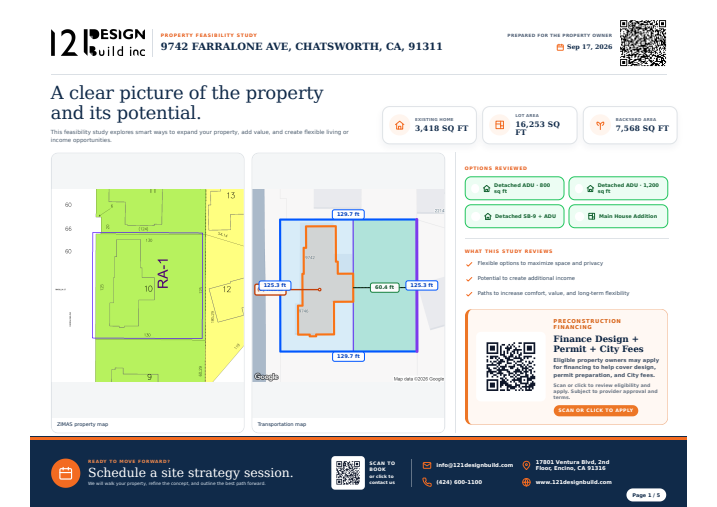
Permit Before Aug 29? What LADBS’s New Linkage Fee Rates Mean for an LA Addition vs an ADU

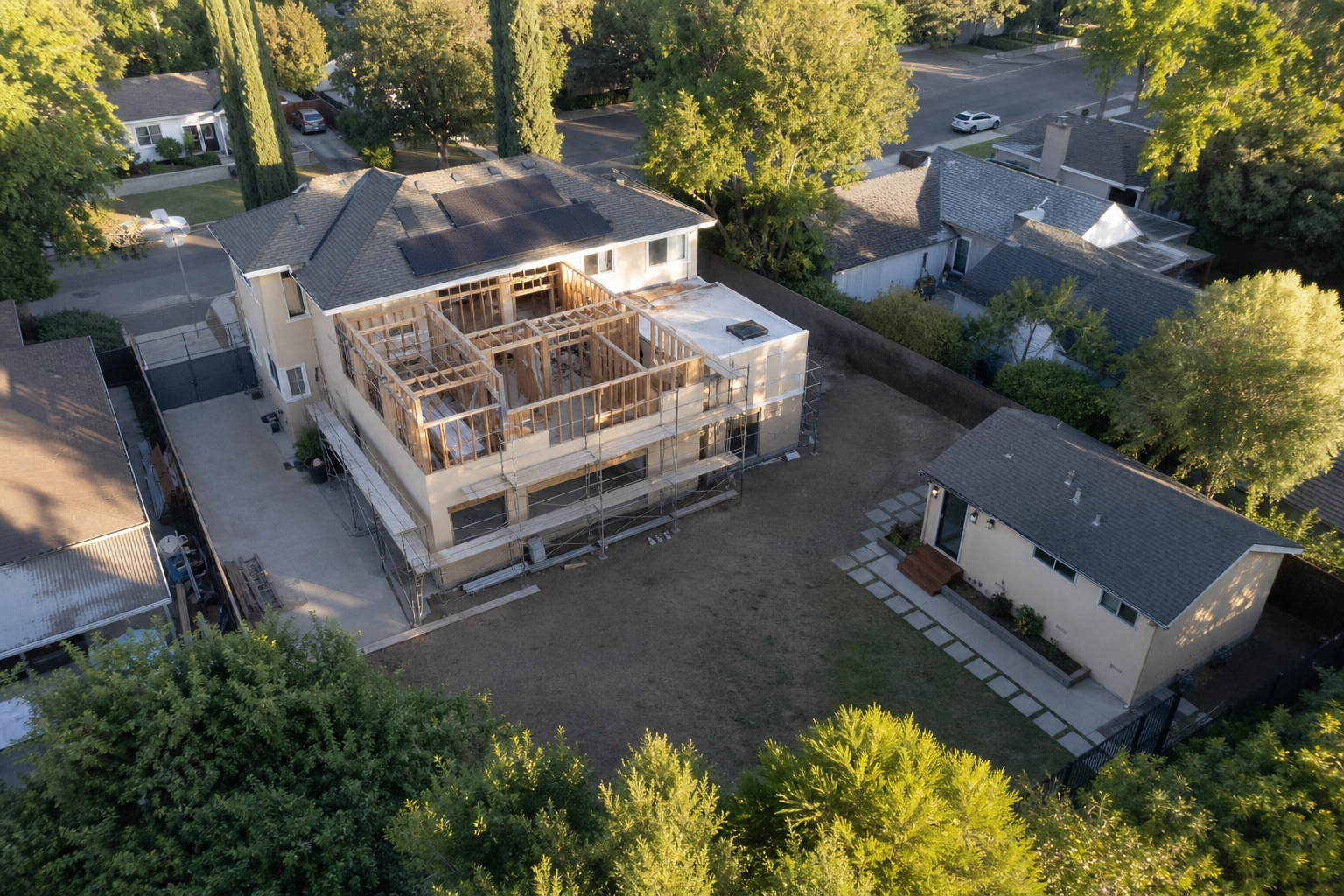
Quick answer: Decide the product before Saturday’s LADBS cutover, not the floor-plan style. An accessory dwelling unit stays off the City of Los Angeles Affordable Housing Linkage Fee ledger. A large main-house addition can land on it, and the bill is due when the building permit issues — not when you hire a designer. LADBS posted on August 24, 2026 that the latest AHLF rates will be implemented in its systems on Saturday, August 29, 2026, with online payment services offline Friday, August 28, 5:00 PM through Saturday, August 29, 1:00 AM. Encino owners should pick ADU versus addition, and who will actually pull the permit, before that load. Do not confuse this fee with City Planning’s 2026 General Plan Maintenance Surcharge, which we already covered as a separate Planning-fee percentage.
The Affordable Housing Linkage Fee (AHLF) is Los Angeles Municipal Code Section 19.18: a per-square-foot charge on certain market-rate residential and commercial Development Projects, paid into affordable-housing funding. Net new residential floor area is the new or added Floor Area LADBS counts after subtracting eligible demolished floor area from the prior year. A Market Area is the Low / Medium / Medium-High / High geography that sets the rate; since April 24, 2026 the maps are neighborhood-level, and the live lookup is ZIMAS under the Planning and Zoning tab. An ADU is a complete independent dwelling on the same lot as a primary residence. An addition in this article is extra floor area on the main house, not a backyard unit. A JADU is a junior unit of no more than 500 square feet of interior livable space inside a single-family dwelling or attached garage. An SB 9 second unit is a second primary dwelling, not an ADU.
Key Takeaways
- The hire decision is ADU versus a large main-house addition versus waiting past August 29 — and who files the building permit. Split design from a later contractor is how the fee is discovered at permit pull.
- LADBS’s August 24, 2026 notice states, in full: “The latest Affordable Housing Linkage Fee rates will be implemented in our systems on August 29, 2026. Online payment services will be offline during scheduled maintenance from August 28, 5:00 PM to August 29, 1:00 AM.” That is a systems-load date, not a new ordinance effective date.
- AHLF is due and payable by the Applicant prior to issuance of a building permit, not at certificate of occupancy and not at schematic design. LAMC 19.18 C.5. No extra AHLF is due solely to extend an expired building permit. Refunds are available if the building-permit application expired and was not used to begin construction.
- ADUs are named as exempt in LAMC 19.18. ZA Memorandum No. 143 states that ADUs and JADUs are exempt from AHLF (LAMC 19.18) and from Park Fees (LAMC 12.33). Size does not put a qualifying ADU onto this ledger.
- The single-family threshold is a cliff, not a deductible. Ordinance No. 185342 / LAMC 19.18 B.2 exempts an addition of 1,500 square feet or less of Floor Area to an existing single-family detached home in a single-family or multiple-family zone; new construction of a single-family detached home in a single-family zone that is 1,500 square feet or less; and a replacement with a net increase of 1,500 square feet or less. An addition of 1,501 square feet or more in a single-family zone, or a replacement with a net increase of 1,501 square feet or more, can stay off the invoice if a covenant is recorded requiring payment if the home is sold within three years of permit issuance. City Planning’s April 22, 2026 implementation memo: if not exempt, all net new floor area added to the site is charged.
- Do not confuse AHLF with the City Planning General Plan Maintenance Surcharge that moved from 7% to 10% on June 9, 2026. GPMS is a percentage on qualifying Planning fees. AHLF is a per-square-foot charge at LADBS building-permit issuance. Our ADU permit-cost post is the GPMS article. This post is not that fee.
- City Planning’s May 26, 2026 sheet is the Affordable Housing Linkage Fee Schedule Effective July 1, 2026: a 3.7% CPI-U adjustment (Los Angeles–Long Beach–Anaheim, 12 months ending April 2026). We quote dollars only from that sheet and from the July 1, 2025 table still published by LAHD. We could not cleanly read every residential Market Area cell on the scanned 2026 sheet; we do not invent the missing High-area residential dollars.
- Encino is City of Los Angeles / LADBS, not County Building and Safety. The 2026 maps list Encino as neighborhood 31 on the key. We did not find a sentence on the official pages that assigns Encino a Low / Medium / Medium-High / High color. Look the address up in ZIMAS.
What is changing at LADBS on August 29, 2026?
LADBS is loading the latest Affordable Housing Linkage Fee rates into its systems on Saturday, August 29, 2026. That is the sentence on the department’s August 24, 2026 notice. The same notice says online payment services will be offline during scheduled maintenance from August 28, 5:00 PM to August 29, 1:00 AM. Anyone trying to pay an LADBS invoice online in that window is in the outage, not only AHLF payers. The notice does not rewrite LAMC 19.18. It does not create a new exemption. It does not say the fee is optional until Saturday.
The legal rate change already happened on July 1. City Planning’s May 26, 2026 memorandum from Director Vincent P. Bertoni states that the calculated inflation adjustment to take effect on July 1, 2026 is 3.7%, based on the CPI-U average for the 12-month period ending April 2026, and that “all projects subject to the AHLF shall pay the applicable fee amount in place at the time of building permit issuance.” The neighborhood Market Area maps already took effect April 24, 2026, after City Council adopted them by resolution on March 25, 2026. Saturday is when LADBS’s cash registers catch up to that latest schedule.
So the Encino question is not “does AHLF exist after August 29?” It exists now. The question is whether your job is even on the ledger, and whether the permit that will actually issue should issue before or after the systems load. An ADU that is exempt on Wednesday is still exempt on Saturday. A 2,200-square-foot main-house addition that is not exempt is on the ledger either way; after Saturday, LADBS systems will be billing the latest published rates.
Do not file a thin set on Friday afternoon to “beat” a computer. Incomplete drawings miss the ADU completeness clock we covered in the 2026 ADU law post, and they do not freeze an AHLF rate. The fee follows issuance, not the date you uploaded a PDF.
When does an Encino / LA addition pay AHLF, and when does an ADU not?
Start with the ordinance definition, then the exemptions. LAMC 19.18 applies to a Development Project unless an exemption in 19.18 B.2 applies. LADBS decides the exemption from documentation the Applicant submits before the building permit issues.
LAHD’s background page (last modified March 4, 2026) restates the Development Project triggers as: additional dwelling units or guest rooms; additional nonresidential floor area; a single-family residential project that results in a net increase of more than 1,500 square feet of floor area, unless not sold within three years; or a change of use from nonresidential to residential. City Planning’s April 22, 2026 implementation memo uses the same four-part list, and it is explicit that the Linkage Fee is due prior to issuance of a building permit — “i.e. not a demolition permit or grading permit.”
ADU. Ordinance No. 185342 exempts “An Accessory Dwelling Unit as defined by California Government Code Section 65852.2.” That Government Code section has since been recodified into the 66310 series; the city’s current ADU implementation memo is the document plan check actually uses. ZA Memo 143, Section III.D, states: “ADUs and JADUs are exempt from Park Fees (LAMC 12.33) and the Affordable Housing Linkage Fee (LAMC 19.18).” That is the city talking to itself. A detached new ADU, a garage conversion ADU, and a JADU are the units to keep on this side of the ledger. The state 750-square-foot impact-fee rule is a different statute. Clearing 750 square feet does not create the AHLF exemption, and going over 750 does not remove it. AHLF’s ADU line is a named exemption, not a size test.
Main-house addition. Quote the statute, not a rumor. LAMC 19.18 B.2, as adopted in Ordinance 185342 and as the current AmLegal text still shows, does not apply the fee to a single-family detached home meeting one or more of these conditions:
- Any addition of 1,500 square feet or less of Floor Area to an existing single-family detached home located in a single-family or multiple-family zone.
- New construction of any single-family detached home located in a single-family zone that is 1,500 square feet or less of Floor Area.
- Any replacement of a single-family detached home resulting in a net increase of 1,500 square feet or less of Floor Area from the prior home that existed on the property.
Then the next paragraph: either (1) an addition of 1,501 square feet or more of Floor Area to an existing single-family detached home located in a single-family zone, or (2) a replacement with a net increase of 1,501 square feet or more, can proceed if a covenant is recorded before permit issuance requiring the owner to pay the Linkage Fee if the home is sold within three years of that permit. The covenant expires if there is no sale in those three years. If there is a sale, it does not expire until the fee is paid, using the schedule in effect at payment. Planning’s April 22, 2026 memo summarizes the same split as “< 1,500 SF” versus “> 1,500 SF … and home remains under same ownership for three years,” and it adds the sentence owners miss: “If not exempt, all net new floor area added to the site is charged the fee.” LAHD’s public background page says “less than 1,500 of net square feet” as a staff summary. The ordinance PDF we fetched uses “1,500 square feet or less” and “1,501 square feet or more.” Have LADBS apply the code section to your drawings. Do not treat 1,501 square feet as “one extra dollar on one extra foot.”
Two more statutory edges. The 1,501-and-covenant path for an addition is written for a single-family zone, not for an addition to a house in a multiple-family zone. New construction of a large single-family house (not an addition, not a replacement) is not in that covenant paragraph; a new house of 1,500 square feet or less in a single-family zone is exempt, and a larger new house is a different file. We are not inventing a workaround for a 4,000-square-foot spec house.
JADU. The adopted AHLF ordinance names Accessory Dwelling Units. It does not say “JADU” in the exemption paragraph we fetched. ZA Memo 143 does, in the impact-fee section quoted above. For an Encino owner, that is the implementation document to put next to the ADU drawings. A JADU that is really a 900-square-foot addition with a wet bar is not a JADU. Call it what LADBS will call it.
SB 9 second primary. Additional dwelling units are a Development Project. The ADU exemption is an ADU exemption. City Planning’s SB 684 implementation memo, which is a different statute, is explicit that those small-subdivision units “will also be assessed any applicable development impact fees such as the LAUSD Developer Fee, Park Fee, and the Affordable Housing Linkage Fee.” We did not find a parallel sentence that exempts an SB 9 two-unit development from AHLF. Do not assume the backyard-cottage exemption covers a second primary. Our extra-units post is the stack conversation. This post is the fee that can attach to the non-ADU pieces of that stack.
If you permit an ADU and a large addition on the same set, do not expect the ADU tail to wag the addition. Concurrent ADU-plus-addition filing is allowed; ZA Memo 143 describes it. The ADU can stay exempt while the addition is tested against the 1,500-square-foot line on its own.
Should you pull the permit before August 29 or wait?
Pull it before August 29 only if the set is actually complete and the job is on the AHLF ledger. Wait if the job is an ADU or JADU — Saturday does not put those units on this invoice. Wait if the drawings are not ready. File a complete addition or new-house set when it is ready, and price the fee that will be due at issuance.
Today is Wednesday, August 26, 2026. The outage starts Friday at 5:00 PM. Saturday 1:00 AM the payments window reopens and the new rates are in the systems. That is three calendar days, not three months of design. An Encino owner who already has a complete, code-coordinated addition set in plan check, and who knows the project is over the 1,500-square-foot line without a three-year covenant, can ask the assigned plan check / zoning reviewer whether the permit can issue before the load, and which schedule the invoice will use. An owner who is still arguing over a great-room roof pitch cannot manufacture a permit by Friday.
The ordinance already says you pay the schedule and Market Area maps in effect at issuance. Planning’s July 1, 2026 sheet is already the current legal schedule. The August 29 event is LADBS implementing those latest rates in its systems. We will not promise that a permit issued Thursday is billed the July 2025 table. Ask LADBS on the case. We will also not tell you to delay a ready ADU until after Saturday. The ADU is not why this notice exists.
If the real product is extra doors, permit the ADU / JADU path that state law already requires the city to accept, and hold a large main-house addition until you have decided whether you want that house enough to pay AHLF on all net new floor area, or to record the three-year covenant, or to stay at or under 1,500 square feet. That is a design decision. It is not a Friday fire drill. See also the two-detached hold in our AB 956 post: do not pay for drawings the city cannot accept this week.
How is the fee calculated (and what we will not invent)?
LADBS (Planning’s April 22, 2026 memo also names City Planning’s Zoning Review Section) calculates AHLF as: net new or added floor area devoted to the scheduled uses, after subtracting eligible demolished floor area from the prior year; multiplied by the applicable per-square-foot rate for that use and Market Area at the time the building permit is issued; minus credits. The Applicant pays it. The original 2018–2019 phase-in fractions are spent. Annual inflation is CPI-U each July 1. Market Area maps may be updated by Council every five years; the 2026 neighborhood maps are the current maps for permits issued on or after April 24, 2026.
LAHD still publishes this table as the Affordable Housing Linkage Fee Schedule Effective July 1, 2025 (page last modified March 4, 2026). City Planning’s April 22, 2026 implementation memo reprints the same dollars and tells readers to check the current schedule Planning maintains:
- Nonresidential uses including hotels: $3.86 Low / $5.16 Medium / n/a Medium-High / $6.44 High, per square foot.
- Residential, 6 or more units in a Development Project: $10.32 / $12.90 / $15.47 / $23.20.
- Residential, 2–5 units: $1.28 / $1.28 / $1.28 / $23.20.
- Residential, single-family detached home: $10.32 / $12.90 / $15.47 / $23.20.
- Net loss of housing units (in addition to any other fees): $3.86 in every Market Area.
City Planning’s May 26, 2026 memorandum is the sheet titled Affordable Housing Linkage Fee Schedule Effective July 1, 2026. It applies a 3.7% CPI-U increase and repeats that the amount due is the amount in place at building-permit issuance. From that official PDF we verified these July 1, 2026 per-square-foot figures: nonresidential including hotels $4.00 Low / $5.35 Medium / n/a Medium-High / $6.68 High. The same PDF extraction also returned $10.70 and $13.38 on the residential single-family and 6-or-more rows and $1.33 on the 2–5-unit row, plus $4.00 citywide for net loss of housing units. The Medium-High and High residential cells on that scanned sheet did not extract cleanly. We are not publishing a guessed High-area single-family dollar. Open the July 1, 2026 PDF and ZIMAS for the address.
We will not multiply those rates by a “typical Encino addition.” We will not assign Encino a Market Area color. Neighborhood 31 on the 2026 key is Encino; the color is on the map and in ZIMAS, not in a sentence we can quote. Sherman Oaks is 85, Tarzana is 92, Van Nuys is 98 — same rule. Look them up.
Design-build vs architect plus a separate contractor when AHLF is in the stack
Hire the team that will classify the job as ADU, JADU, addition, replacement, new house, or SB 9 second primary before schematic hardens, and that will be the Applicant’s permit filer when the invoice prints. An architect-only set that “discovers” AHLF at permit pull is how a 1,600-square-foot family-room addition becomes an all-net-new-floor-area bill, or how a unit drawn as an ADU gets recoded as extra main-house area.
The owner can pick a program: extra rental door, extra bedroom for family, or a bigger primary house. The owner cannot, from a mood board, tell whether that program is 19.18-exempt, 1,500-or-less, 1,501-plus with a three-year covenant, or a full single-family rate on every new foot. That classification is the job. A California-licensed architect stamps architecture. The person who will pay or protest the fee under Government Code Section 66020 needs to sit in the first meeting.
Split design and construction is the expensive version of “we will deal with city fees later.” The addition grows past 1,500 square feet in value engineering. The ADU becomes attached to the house in a way that looks like more primary Floor Area. The contractor who did not run the exemption memo then treats the LADBS invoice as a change order. Encino design-build is the other version: one site plan, one permit strategy, ADU versus addition decided on purpose, and a construction number that includes the fee if the fee is real.
If you already have an architect you trust, keep them — and put the AHLF path in writing before the roof goes on the model: ADU yes or no, JADU yes or no, addition at or under 1,500 or over with covenant or over and pay, SB 9 off the table unless you want a second primary and you have confirmed it is not riding the ADU exemption. If that memo does not exist, you do not have a fee strategy. You have a drawing.
How can 121 Design Build help Encino owners with ADU versus addition before the August 29 load?
121 Design Build is an Encino design-build firm. We will not take a retainer to pretend a large main-house addition is an ADU, and we will not freeze a ready ADU because LADBS is loading a fee that does not apply to that unit. For a homeowner choosing extra floor area on a Ventura Boulevard–corridor, south-of-the-Boulevard, or Valley lot, start with the product. Our ADU & JADU service is the path that stays off the AHLF ledger under LAMC 19.18 and ZA Memo 143. Our Addition & Remodel service is the path that has to be sized, covenanted, or paid. If the long-term play is a second primary dwelling, that is a different statute and a different fee conversation.
We have not published an AHLF invoice as a case study, and we are not going to invent one. What we will do is read the lot, the existing house, and the program against 19.18 B.2 and the current Planning schedule, then file the permit as one team so the exemption or the invoice is not a surprise at issuance. GPMS, school fees, and sewer charges are other lines. They are not this line.
121 Design Build is at 17801 Ventura Blvd, 2nd floor, Encino, CA 91316. Call (424) 600-1100 or (424) 600-2100, email info@121designbuild.com, or visit https://www.121designbuild.com/. To review an Encino or Los Angeles ADU-versus-addition path before the August 29 systems load — or after it — contact 121 Design Build or call (424) 600-2100. Bring the address, a target size, and whether you mean a backyard unit or a bigger main house. We will price the stack that LADBS will actually permit.
Frequently Asked Questions
Is AHLF the same as the 10% Planning surcharge?
No. AHLF is LAMC 19.18, a per-square-foot charge at building-permit issuance. The General Plan Maintenance Surcharge is a percentage on qualifying City Planning fees, 10% as of June 9, 2026. See our ADU permit cost post for GPMS. Do not add 10% to an AHLF invoice or add AHLF to an ADU that is exempt from 19.18.
Does an Encino ADU pay the Affordable Housing Linkage Fee after August 29?
Not because of August 29. ADUs are exempt by LAMC 19.18. ZA Memo 143 says ADUs and JADUs are exempt from AHLF. Saturday’s systems load updates rates for projects that are on the ledger. It does not put a qualifying ADU onto the ledger.
When does a main-house addition pay AHLF?
When it is a Development Project that does not qualify for a 19.18 B.2 exemption. The ordinance exempts an addition of 1,500 square feet or less of Floor Area to an existing single-family detached home in a single-family or multiple-family zone. At 1,501 square feet or more in a single-family zone, a recorded three-year no-sale covenant can keep the invoice off until a sale, if there is a sale. If not exempt, Planning says all net new floor area is charged. Confirm on the drawings with LADBS.
Is the fee due at certificate of occupancy?
No. LAMC 19.18 C.5: due and payable by the Applicant prior to issuance of a building permit. Planning’s 2026 memo: building permit, not demolition or grading. The amount is the schedule and maps in effect at issuance.
Who pays, and can I get a refund?
The Applicant pays. A refund is available if the building-permit application expired and was not used to begin construction. Credits for change of use, restricted affordable floor area, and certain mixed-use and land-dedication items are in 19.18 C.4; a change-of-use credit cannot produce a cash refund or a credit on a different site. Protests follow Government Code Section 66020 and 19.18 B.3.
What Market Area is Encino?
We are not guessing. The 2026 maps use neighborhood geography; Encino is listed as neighborhood 31 on City Planning’s key. Look the parcel up in ZIMAS, Planning and Zoning tab. Permits issued on or after April 24, 2026 use the 2026 maps.
Should I rush a filing this week?
Only if the set is complete and the project is actually subject to AHLF. An incomplete ADU set does not beat a rate, because the ADU is exempt. An incomplete addition set does not lock Saturday’s computer. Online payments are down Friday 5:00 PM to Saturday 1:00 AM.
Does a new single-family house pay AHLF?
A new single-family detached home in a single-family zone that is 1,500 square feet or less of Floor Area is in the exemption list. A larger new house is not in the 1,501-square-foot covenant paragraph, which is written for additions in a single-family zone and for replacements. Confirm the file type with LADBS. Do not call a new house an addition to borrow the covenant.
Does an SB 9 duplex get the ADU exemption?
We did not find that exemption. Additional dwelling units are a Development Project. The named exemption is for an Accessory Dwelling Unit. Confirm the SB 9 file with LADBS and City Planning before anyone prices it as “free of AHLF because it is kinda like an ADU.”
Is Encino under Los Angeles County for this fee?
No. Encino is in the City of Los Angeles. AHLF is a City of Los Angeles fee administered at building-permit issuance by LADBS. County Building and Safety is the wrong window.
Is this legal advice?
No. This article is general information from a design-build and permitting perspective. Confirm current AHLF rates, Market Area, exemptions, and the amount due on your specific address with LADBS, City Planning, and, if needed, your own attorney.
Sources
- LADBS: Attention: The latest Affordable Housing Linkage Fee rates will be implemented in our systems on August 29, 2026 (August 24, 2026)
- Los Angeles Municipal Code Section 19.18, Affordable Housing Linkage Fee
- City of Los Angeles: Ordinance No. 185342 (Affordable Housing Linkage Fee)
- Los Angeles Housing Department: Affordable Housing Linkage Fee Background (last modified March 4, 2026)
- Los Angeles City Planning: Housing Policy (AHLF documents)
- Los Angeles City Planning: AHLF Implementation Memo (April 22, 2026)
- Los Angeles City Planning: AHLF Fee Schedule with 2026 Market Area maps (April 22, 2026)
- Los Angeles City Planning: Affordable Housing Linkage Fee Schedule Effective July 1, 2026
- Los Angeles City Planning: Affordable Housing Linkage Fee Schedule Effective July 1, 2025
- Los Angeles City Planning / LADBS: ZA Memorandum No. 143 (December 30, 2024)
- Los Angeles City Planning: SB 684 Implementation Memo (AHLF on those units)
- City of Los Angeles: ZIMAS
- 121 Design Build: ADU Permit Cost in Los Angeles 2026 (GPMS, not AHLF)
- 121 Design Build: How Many Extra Units Can You Put on One LA Lot in 2026?
- 121 Design Build: Los Angeles ADU Law Changes 2026
- 121 Design Build: Two Detached ADUs on One LA Lot? AB 956
This article is general information from a design-build and permitting perspective and is not legal advice. Confirm current AHLF rates, Market Area, exemptions, and the amount due on your specific address with LADBS and City Planning. August 29, 2026 is described here as LADBS’s published systems-load date for the latest AHLF rates, not as a new ordinance effective date.
#AHLF #AffordableHousingLinkageFee #LADBS #LAMC1918 #LosAngelesADU #Encino #JADU #SB9 #HomeAddition #DesignBuild #SanFernandoValley #LAHomeowners #PermitFees #ADU2026
Browse Our Related Articles & Blogs
Dive into a wide range of blog posts featuring the latest projects, creative design ideas and innovative sustainable practices. Stay informed with expert industry updates that shape the future of construction.


Frequently Asked Questions
Can’t find the answer you’re looking for? Please contact with our customer service.
Can’t find the answer you’re looking for? Please contact with our customer service.
Ready to build Smarter?
Book your free consultation today and discover how quickly we can turn your ideas into permits and long-term property value. Our team is here to guide you from the first sketch to final approval.