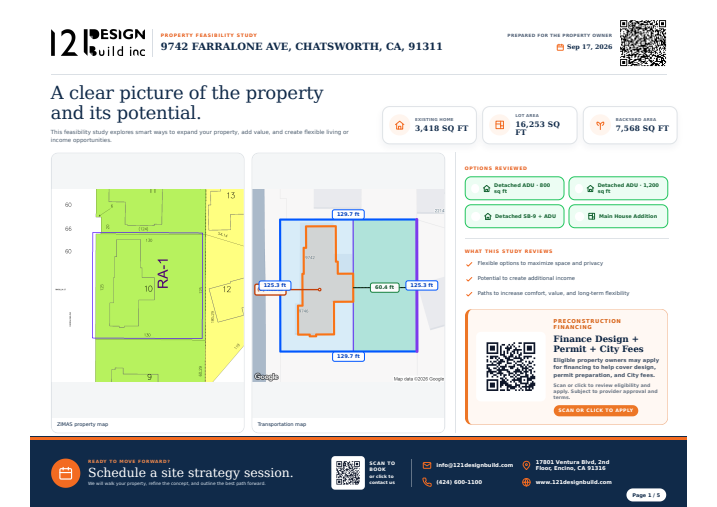
How Many Extra Units Can You Put on One LA Lot in 2026? Detached ADU, JADU, and an SB 9 Unit


Quick answer: On many Los Angeles single-family lots, the extra-unit conversation in 2026 is no longer “one backyard cottage.” A common five-unit mix is the main house, a second primary dwelling under SB 9 (the spin-on unit), a new detached ADU, a junior ADU inside the main house or attached garage, and a conversion ADU from existing space. That stack is a planning strategy, not a guaranteed permit. LADBS still reviews the parcel, and a lot split can cut the count instead of raising it.
An accessory dwelling unit, or ADU, is a secondary residential unit on the same lot as a primary home. A junior ADU, or JADU, is a smaller unit created within a single-family residence or attached garage. An SB 9 spin-on unit is a second primary dwelling on a qualifying lot under the two-unit rules, not an ADU.
Key Takeaways
- A practical five-unit picture on one unsplit Los Angeles single-family lot is: existing main house, SB 9 second primary dwelling, new detached ADU, JADU, and a conversion ADU from a garage or other existing space.
- State ADU law and SB 9 are different statutes. Mixing them is how owners get past “one extra unit,” but HCD’s SB 9 materials still say SB 9 does not require a city to allow more than four units on a single lot. The 2026 ADU Handbook discussion is more generous when the lot is not split. That tension is why a parcel study comes first.
- A JADU stays inside the main house or attached garage, generally at no more than 500 square feet of interior livable space, with an efficiency kitchen and a separate entrance.
- A new detached ADU is a separate structure. The state-protected path many owners use is a compact detached unit, often discussed around 800 square feet of interior livable space, with four-foot side and rear setbacks.
- An SB 9 lot split is usually the wrong move if the goal is five units on one lot. After a split, each new parcel is commonly capped at two dwellings, counting primaries, ADUs, and JADUs together.
- Encino, Sherman Oaks, Van Nuys, Tarzana, and other Valley lots are often the right size for this conversation. Hillside, HPOZ, coastal, and very high fire hazard parcels are not automatic yeses.
- This is a design, zoning, and permitting problem. It is not a floor-plan download.
What is a five-unit single-family lot strategy in Los Angeles?
A five-unit single-family lot strategy in Los Angeles is a way to use the main house plus extra dwellings the state already recognizes: a second primary unit, a detached ADU, a JADU, and a conversion ADU. It is not a rezoning to apartments, and it is not an ED-1 affordable-housing project.
The reason this topic is moving in 2026 is that ADU law, JADU rules, and SB 9 two-unit rules now sit on the same lots, and HCD’s updated ADU Handbook is being read as allowing more combinations on an unsplit lot than older four-unit talking points. That does not mean every R1 lot in Encino can take five doors. It means owners should stop asking only “Can I build an ADU?” and start asking “Which combination does this lot actually support?”
121 Design Build looks at that question as one site plan. The main house stays. The spin-on unit is tested as a second primary dwelling. The detached ADU is tested in the yard. The JADU is tested inside. The conversion is tested in the garage or other existing space. If one of those five fails, the project is four, three, or two units. That is still often a better outcome than forcing a five-unit diagram onto a lot that cannot park, sewer, or separate the buildings.
What is a detached ADU vs a JADU vs an SB 9 spin-on unit?
A detached ADU is a separate dwelling in the yard, with its own entrance, kitchen, and bathroom. It is the unit most Los Angeles owners mean by “backyard house.” It can be one story or two stories, subject to height, setback, and fire rules. It is accessory to the primary home, not a second main house.
A JADU is smaller and cheaper because it lives inside the existing or proposed single-family dwelling or attached garage. It is capped at 500 square feet of interior livable space, needs an efficiency kitchen and a separate entrance, and may share a bathroom with the main house. Under AB 1154, owner-occupancy is required when the JADU shares sanitation facilities. A JADU with its own bathroom is a different rental and occupancy story. A JADU is not a detached cottage.
An SB 9 spin-on unit is a second primary dwelling on a qualifying single-family lot, using the two-unit development path in state law. It is not an ADU. It counts as another main unit. That is why owners use it when they want a full second house, not a 500-square-foot junior unit and not only a backyard ADU. Parking, occupancy affidavits, historic and fire overlays, and lot size still apply. If the lot does not qualify for SB 9, the spin-on unit is off the table and the extra-unit plan falls back to ADUs and a JADU.
A conversion ADU is the fifth piece in this article’s five-unit mix. It is an ADU created from existing space: a garage, guesthouse, recreation room, or similar structure. It is often the fastest extra door because the envelope already exists. It is also where unpermitted work, slab problems, and ceiling height show up.
How can a Los Angeles single-family lot reach five units?
The five-unit mix we are describing, including the main house, is:
- The existing primary house.
- An SB 9 spin-on unit: a second primary dwelling on the same unsplit lot.
- A new detached ADU in the yard.
- A JADU inside the main house or attached garage.
- A conversion ADU from existing space, most often a garage.
That reading follows the 2026 extra-unit conversation: keep one lot, add a second primary under SB 9, and still use state ADU law for a detached unit, a junior unit, and a conversion. Some handbook commentary goes even higher, toward six units, by adding another ADU configuration under local standards. 121 Design Build does not sell six units as a default. Five is already an aggressive, site-specific plan.
HCD’s older SB 9 fact sheet still says SB 9 does not require a local agency to allow more than four units on a single lot. Cities can allow more. They are not always required to. Los Angeles homeowners should treat five units as a feasibility question for LADBS and City Planning, not as a state coupon.
On a typical Valley lot, the first test is geometry. Encino and Sherman Oaks lots can take a detached ADU and still leave a workable yard. A JADU can sit in a converted bedroom wing or attached garage. A spin-on unit needs its own building envelope, setbacks, and a path that does not kill the detached ADU. If the garage conversion is also in play, the driveway, parking replacement, and sewer wye have to work together. That is why this is one coordinated permit set, not four separate weekend projects.
When does an SB 9 lot split change the unit count?
An SB 9 lot split usually lowers the extra-unit count on each new parcel. After a split, state SB 9 rules commonly allow two dwellings per resulting lot, and those two can be two primaries, or a primary plus an ADU, or a primary plus a JADU. ADUs and JADUs count toward that two-unit cap on a split lot.
If the goal is five units on the property you already own, splitting first is often the wrong sequence. The five-unit story in this article assumes one lot, no split, a second primary dwelling, and ADU law still applying to that lot. If the owner’s real goal is to sell one of the new parcels, a split can still make sense. That is a different project, with a three-year occupancy affidavit on many SB 9 splits, civil work, and a much smaller unit mix on each side.
Los Angeles already showed that most 2024 SB 9 activity was backyard two-unit work, not lot splits. For Encino and SFV owners chasing extra doors, the spin-on second primary plus ADUs is usually the conversation. The split is the exception.
What should LA homeowners check before chasing five units?
LA homeowners should start with the lot, not the unit count. Zoning, overlays, lot area, existing buildings, sewer, power, trees, slope, and access decide the mix before any floor plan does.
Check whether the parcel even qualifies for SB 9 two-unit development. Historic properties, very high fire hazard severity zones, and some coastal or hillside conditions can block or reshape the spin-on unit. Encino is City of Los Angeles, so the file still goes through LADBS and City Planning, not a separate Encino building department.
Check whether the detached ADU is a new building or a replacement of an existing accessory structure. Height matters if you want two stories. State height rules for detached ADUs are not a free extra story on every lot.
Check the JADU bathroom decision. Shared sanitation can keep cost down and trigger owner-occupancy. A separate bathroom can cost more and rent more cleanly.
Check whether the garage conversion is a conversion ADU, a JADU, or both in the owner’s mind. It cannot be both in the same square footage. One enclosed garage is usually one extra unit, not two.
Check legalization if the extra unit already exists without permits. Pre-2020 unpermitted ADUs and JADUs may have a path under AB 2533, but that is a records and health-and-safety project, not a shortcut to five new doors.
How should owners plan design and permits for a five-unit lot?
Owners should plan a five-unit lot as one feasibility study, one site plan, and a staged permit strategy. Trying to pull a JADU permit this month, an ADU next year, and an SB 9 unit after that is how utility, fire separation, and parking decisions collide.
A complete first study should show all five dwellings, even if phase one is only the JADU and conversion. The detached ADU and spin-on unit still need a place to land. If they do not fit, the marketing promise of five units is false, and the owner should hear that before paying for construction drawings.
The 2026 completeness clock on ADU and JADU applications helps only when the drawings are actually complete. Title 24, structural, sewer, fire, and hillside notes still sit on the critical path. An SB 9 second primary has its own findings and forms. A design-build team that prices construction against those drawings early will kill bad options before plan check does.
For many 121 clients, a smart sequence is: confirm the five-unit diagram, permit the conversion and JADU first if they are the cheapest doors, then the detached ADU, then the spin-on primary if the lot and the financing still support it. Sequence is a business decision. The site plan still has to show the end state.
How can 121 Design Build help with extra units on a Los Angeles lot?
121 Design Build helps Los Angeles property owners test extra-unit strategies the same way we run ADU, JADU, SB 9, and new-construction work: feasibility first, then permit-ready drawings, then a construction path. For an Encino or Valley owner who wants a detached ADU, a JADU, and an SB 9 spin-on unit on one single-family lot, the first deliverable is a lot screen, not a pretty five-unit rendering.
Our ADU & JADU service covers the accessory units. SB9 planning covers the second primary dwelling. Addition & Remodel covers the interior JADU and garage conversion. The point of combining them is to keep one site plan so the fifth unit does not erase the third.
If you want to know whether your lot can hold the main house plus a detached ADU, a junior ADU, and a spin-on SB 9 unit, contact 121 Design Build or call (424) 600-2100. Bring the address. We will tell you which of the five units actually fit before you commit to a plan set.
Frequently Asked Questions
Can I really put five units on a single-family lot in Los Angeles?
Sometimes. A five-unit mix of main house, SB 9 second primary, detached ADU, JADU, and conversion ADU is the strategy this article describes. It depends on the parcel, overlays, and how LADBS reads ADU law together with SB 9. It is not guaranteed on every R1 lot.
What is the spin-on unit?
In this article, the spin-on unit is the second primary dwelling under SB 9 two-unit rules. It is a full extra house on the same lot, not a JADU and not a backyard ADU. If the lot does not qualify for SB 9, that unit drops out of the mix.
Does a JADU count as one of the extra units?
Yes. A JADU is its own dwelling. It counts toward extra units and, after an SB 9 lot split, toward the two-unit cap on each new parcel.
Should I split the lot to get more units?
Usually not if the goal is five units on the land you already have. A split often caps each new lot at two dwellings. Split when you want to sell a parcel, not when you want the maximum door count on one lot.
Can the detached ADU be two stories?
Often yes, subject to height, setbacks, and the existing house. Two stories help on smaller Encino lots because you get more interior space without eating the whole yard. Height and fire rules still have to clear LADBS.
Is this legal advice?
No. This article is general information from a design-build and permitting perspective. Zoning, SB 9 eligibility, and ADU counts should be confirmed on your specific address.
Sources
- California HCD: Accessory Dwelling Units and ADU Handbook
- California Legislative Information: SB 9 bill text
- LADBS: ADU information and permitting
- LADBS: Senate Bill 9 Two-Unit Development and Urban Lot Split
This article is general information from a design-build and permitting perspective and is not legal advice.
#LosAngelesADU #JADU #SB9 #DetachedADU #FiveUnits #LADBS #Encino #SanFernandoValley #ADUPermits #DesignBuild #LAHomeowners
Browse Our Related Articles & Blogs
Dive into a wide range of blog posts featuring the latest projects, creative design ideas and innovative sustainable practices. Stay informed with expert industry updates that shape the future of construction.


Frequently Asked Questions
Can’t find the answer you’re looking for? Please contact with our customer service.
Can’t find the answer you’re looking for? Please contact with our customer service.
Ready to build Smarter?
Book your free consultation today and discover how quickly we can turn your ideas into permits and long-term property value. Our team is here to guide you from the first sketch to final approval.