Prefab or Site-Built ADU in Encino After AB 1815? Who to Hire Before the January 2027 Factory-Built Rules


Quick answer: On September 29, 2026, Governor Newsom signed AB 1815 (Chapter 782) and AB 2058 (Chapter 783), and both take effect January 1, 2027. AB 1815 bars cities, including Los Angeles, from imposing local building standards on a qualifying factory-built housing structure that exceed or differ from the California Building Standards Code, unless the city adopts a findings-based amendment for local climatic, geological, or topographical conditions. AB 2058 caps local permitting fees for factory-built housing structures at 50 percent of the equivalent fee for site-built housing unless the city documents higher costs, and sets up a later option for installation inspections by a state-supervised quality assurance agency. Neither law changes zoning, setbacks, fire zones, site development, foundations, utility service, or the fact that LADBS still permits and inspects the work on your Encino lot. For most owners, the real hiring decision is not prefab versus site-built. It is whether one team owns the site, foundation, utilities, permits, and installation from start to finish, whichever building method you choose.
An ADU (accessory dwelling unit) is a secondary home with independent living facilities on the same lot as a primary house. Factory-built housing is defined in California law as a residential building, dwelling unit, component, assembly, or system made wholly or in substantial part offsite, so concealed parts cannot be inspected at the site without disassembly, and built to the California Building Standards Code under the HCD program. Modular usually refers to three-dimensional factory-built modules that are craned onto a permanent foundation and carry an HCD insignia. A manufactured home is a different product, built to the federal HUD code, and AB 1815 expressly excludes manufactured homes and mobilehomes from its definition of factory-built housing. LADBS is the City of Los Angeles Department of Building and Safety. HCD is the California Department of Housing and Community Development, which runs the Factory-Built Housing Program and issues the insignia of approval. Encino is part of the City of Los Angeles, so LADBS and LA City Planning apply, not Los Angeles County.
Key Takeaways
- AB 1815 (Wicks) was approved and chaptered on September 29, 2026 as Chapter 782. It adds Health and Safety Code Section 19993.1, which limits local building standards for factory-built housing structures starting January 1, 2027.
- Under AB 1815, a factory-built housing structure is a residential building that is at least two-thirds residential by new or converted square footage, with at least 30 percent of the residential portion built using factory-built housing, as determined by the licensed design professional and subject to HCD or design approval agency concurrence.
- AB 2058 (Harabedian), Chapter 783, caps local permitting fees for factory-built housing structures at 50 percent of the equivalent site-built fee unless the city adopts written findings showing higher reasonable costs.
- AB 2058 also lets a buyer choose a quality assurance agency for installation inspections, but only after HCD adopts regulations, which are due by January 1, 2029. The related installation inspection fee cap waits for those regulations too.
- Zoning, local fire zones, setbacks, side and rear yards, site development, property line rules, and architectural review remain local under Section 19993. LADBS keeps enforcing installation and keeps its certificate of occupancy authority.
- Foundation, grading, trenching, sewer, water, gas, and electrical service are site work. A prefab vendor that only ships a box does not make those items go away.
- This article does not quote prices, fees, or schedules for any project. Every lot is different, and LADBS has not published how it will apply these laws to ADU permits.
What does AB 1815 actually change for a prefab ADU in Encino?
AB 1815 targets local building standards, not local land use. Before this law, the Factory-Built Housing Law already treated an HCD-approved unit bearing the state insignia as compliant with local construction ordinances, and it generally barred cities from requiring plan submittals to re-check the factory work. AB 1815 goes further by adding Section 19993.1, which says a city, county, or district shall not impose or enforce local building standards applicable to a factory-built housing structure that exceed or differ from the mandatory standards in the California Building Standards Code.
The law also bars local energy efficiency and green building amendments to Title 24 Parts 6 and 11 that exceed the state minimums for these structures. Cities can still adopt changes reasonably necessary because of local climatic, geological, or topographical conditions, including wildfire and flood risk, but only with an express written finding that is filed with the California Building Standards Commission before it takes effect. AB 1815 also creates a rebuttable presumption in favor of determinations that allow a project to qualify as a factory-built housing structure.
For an Encino owner, the practical effect is that a qualifying factory-built ADU should be judged against the state code rather than a separate layer of city-only building rules, unless a findings-based local amendment applies. A detached ADU built mostly from HCD-approved modules would appear to meet the 30 percent test, but the bill leaves that call to the licensed design professional with state or agency concurrence, so confirm it early in design. Hillside lots south of Ventura Boulevard and parcels in fire hazard areas are where findings-based local requirements are most likely to matter.
What does AB 2058 change about LADBS fees and inspections?
AB 2058 adds two new sections to the Health and Safety Code. Section 19992.2 says a local enforcement agency shall not impose a permitting fee related to a factory-built housing structure that exceeds 50 percent of the equivalent permitting fee for a non-factory-built structure, unless the agency adopts a written finding and resolution or ordinance with substantial evidence of the reasonable cost to review the permits. That section is not tied to the later HCD rulemaking, so it should apply from January 1, 2027.
Section 19992.1 creates a choice for the first user, meaning the buyer who installs the unit, to have either the local building department or a quality assurance agency acting under HCD supervision inspect the installation. That option, the 50 percent cap on installation inspection fees, and the rule that the city cannot charge an installation inspection fee when a quality assurance agency is used do not become operative until HCD adopts regulations, which the law requires by January 1, 2029. Even then, the city may still charge for sitework inspections not related to installing the factory unit, including grading, foundations, and landscaping. The law also prohibits inspectors from disassembling, damaging, or destroying factory-built housing during installation inspections.
Exactly how LADBS will split an ADU permit between the factory-built structure and the site work it still permits at full rates has not been published. Treat any fee savings as a possibility to confirm with LADBS, not a number to put in your budget yet.
What do these laws not change?
Section 19993, as amended by AB 1815, keeps local use zones, snow and wind load requirements, local fire zones, building setbacks, side and rear yard requirements, site development and property line requirements, and architectural and aesthetic review entirely with local jurisdictions. Those local requirements may not vary substantially from what applies to other residential buildings of similar size, but they still apply. AB 2058 states that nothing in the chapter alters a local agency's authority to issue or withhold a certificate of occupancy, and local enforcement agencies still enforce installation.
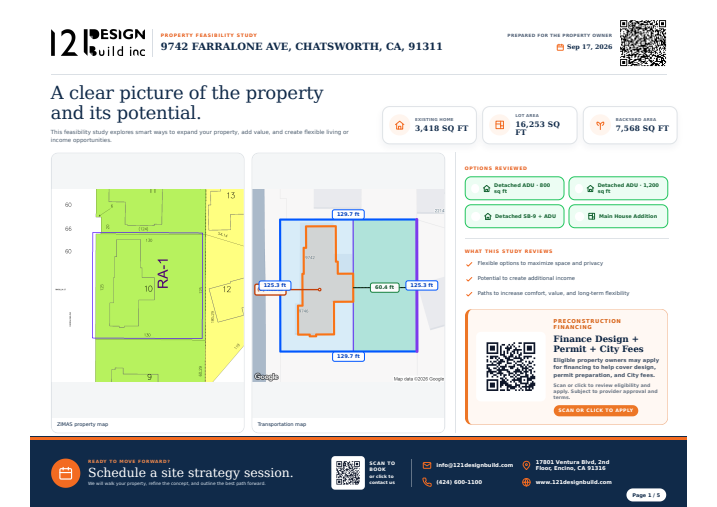
In practice, a prefab ADU in Encino still needs a site plan that works with your lot, a foundation designed for the module and the soil, grading and drainage, sewer and water connections, an electrical service that can carry the new load, fire separation and access that satisfy LADBS and LAFD, and crane and delivery access. None of that is built in a factory. California ADU law, the LA ADU Ordinance, and LADBS ADU bulletins continue to govern size, height, setbacks, and the ministerial review process for both prefab and site-built units.
Prefab vs site-built ADU in Encino: how do they compare?
- Building code path: A factory-built unit is designed to the California Building Standards Code and approved through HCD, and after January 1, 2027 AB 1815 limits extra local building standards for qualifying structures. A site-built ADU is reviewed against the state code plus applicable LA local amendments through LADBS plan check.
- Plan review: For an HCD-approved unit, the city reviews the site, foundation, and installation rather than re-checking the factory work. A site-built ADU gets a full LADBS plan check, or a shorter review if you use an approved plan from the LADBS Standard Plan Program that fits your lot.
- Permit fees: From January 1, 2027, AB 2058 caps permitting fees related to factory-built housing structures at 50 percent of the site-built equivalent unless the city adopts cost findings. Site-built ADUs pay the regular LADBS schedule. Site work fees can apply in both cases.
- Inspections: Factory work is inspected in the plant before the insignia is applied, and LADBS inspects installation and site work. Site-built work is inspected by LADBS at each stage. A quality assurance agency option for prefab installation only arrives after HCD regulations, due by 2029.
- Design flexibility: Prefab layouts follow approved models and module dimensions that must ship by road and be craned into place. Site-built designs can fit odd lot shapes, slopes, tight side yards, or matching architecture more freely.
- Site access: Prefab needs a delivery route and crane setup with clearance over the house, wires, and trees. Site-built needs room for materials and crews but no crane pick.
- What stays the same: Zoning, setbacks, fire zones, site development, foundation, utilities, and the certificate of occupancy remain local in both cases.
Who should you hire for a prefab ADU in Encino?
Many prefab companies sell and manufacture the unit, and some coordinate installation, but the scope that most often drives risk on an LA lot sits outside the factory: surveys, the site plan, soils and foundation design, utility service upgrades, sewer connection, fire separation, crane logistics, and the LADBS permit for the site work. If those pieces are split among a vendor, a separate engineer, and a separate general contractor, the owner ends up coordinating the gaps.
Before you sign with any prefab vendor, ask who prepares and submits the LADBS site and foundation permit, who designs the foundation to the manufacturer's connection details, who handles the electrical service and utility coordination, who manages crane and street logistics, who carries the license and insurance for on-site work, and who is responsible if the module arrives and the site is not ready. Ask to see the HCD insignia and plan approval for the model you are buying.
A design-build firm can run either route. It can test your lot for a prefab model or a custom site-built ADU, prepare the site plan and permit set, build the foundation and utility runs, coordinate the delivery and set, and finish the connections, decks, landscaping, and final inspections. That single point of responsibility matters more than the building method.
Should you file now or wait until January 2027?
It depends on your route. If you are building site-built, AB 1815 and AB 2058 do not change your path, so there is little reason to wait. If you are leaning toward a factory-built unit, the potential benefits start January 1, 2027, and neither bill states how applications already in plan check on that date will be treated. Ask LADBS before you assume a pending application picks up the new fee cap.
A practical middle path is to start feasibility, survey, utility review, and site design now, since that work is needed for either method. That lets you compare a specific prefab model against a site-built design on your actual lot, and time the permit submittal once LADBS clarifies how it will apply the new rules. Other bills signed the same week, including AB 956 on up to two detached ADUs and SB 1117 on ADU impact fees, may also affect planning, as summarized by Allen Matkins.
How can 121 Design Build help?
121 Design Build is an Encino-based design-build firm working across Los Angeles. For an ADU, we start with a feasibility review of your lot, zoning, utilities, access, and site conditions, then compare a factory-built option and a site-built option side by side. Through our ADU and JADU service, whichever route makes sense, we handle design and permit drawings, the LADBS permit process, foundation and utility work, coordination with the prefab manufacturer when one is used, installation, and finish construction through final inspection.
If you are weighing a prefab ADU in Encino before the January 2027 factory-built rules take effect, call 121 Design Build at (424) 600-2100, email info@121designbuild.com, or use our contact page at 121designbuild.com. Our office is at 17801 Ventura Blvd, 2nd floor, Encino, CA 91316.
FAQ
When do AB 1815 and AB 2058 take effect?
Both bills were approved by the Governor and filed with the Secretary of State on September 29, 2026, and take effect January 1, 2027. Parts of AB 2058, including the quality assurance agency inspection option and the installation inspection fee cap, wait until HCD adopts regulations, which are due by January 1, 2029.
Does AB 1815 let me skip LADBS for a prefab ADU?
No. LADBS still permits and inspects the site work and installation, and zoning, setbacks, fire zones, site development, and architectural review remain local. AB 1815 limits extra local building standards for qualifying factory-built structures. It does not remove the local permit.
Is a manufactured home the same as a modular ADU under these laws?
No. AB 1815 defines factory-built housing to exclude manufactured homes, mobilehomes, recreational vehicles, and commercial modulars. A modular ADU under the HCD Factory-Built Housing Program is built to the California Building Standards Code and carries an HCD insignia.
Will AB 2058 cut my ADU permit fees in half?
Not necessarily. It caps permitting fees related to factory-built housing structures at 50 percent of the site-built equivalent unless the city adopts cost findings, but site work such as grading and foundations can still be charged, and LADBS has not published how it will apply the cap. Confirm with LADBS before budgeting savings.
Is prefab always faster or cheaper than site-built in Encino?
Not always. Factory production can overlap with site work, but foundation, utilities, permits, access, and crane logistics still drive the schedule and cost on a real lot. Compare both routes on your property before deciding.
Should a design-build firm or a prefab vendor pull the permit?
Whoever pulls the permit should also own the site plan, foundation, utilities, and installation coordination. If the vendor does not cover those items in writing, a design-build firm can manage the full scope and coordinate with the manufacturer.
Sources
- California Legislative Information: AB 1815, Factory-built housing: building standards and local requirements (Chapter 782, Statutes of 2026)
- California Legislative Information: AB 2058, California Factory-Built Housing Law (Chapter 783, Statutes of 2026)
- Allen Matkins: Governor Newsom Signs Key Housing Bills Into Law (October 1, 2026)
- California HCD: Factory-Built Housing Program
- California HCD: Factory-Built Insignia
- California HCD: Manufactured Housing Laws and Regulations
- LADBS: Accessory Dwelling Unit (ADU)
- LADBS: Standard Plan Program
This article is general information about California and Los Angeles rules as of October 6, 2026. It is not legal advice. Confirm current requirements with LADBS, HCD, and qualified professionals for your property.
#PrefabADU #EncinoADU #ADU #AB1815 #AB2058 #FactoryBuiltHousing #ModularADU #LADBS #LosAngelesADU #DesignBuild #121DesignBuild
Browse Our Related Articles & Blogs
Dive into a wide range of blog posts featuring the latest projects, creative design ideas and innovative sustainable practices. Stay informed with expert industry updates that shape the future of construction.


Frequently Asked Questions
Can’t find the answer you’re looking for? Please contact with our customer service.
Can’t find the answer you’re looking for? Please contact with our customer service.
Ready to build Smarter?
Book your free consultation today and discover how quickly we can turn your ideas into permits and long-term property value. Our team is here to guide you from the first sketch to final approval.