SB 876 and Your Encino ADU: Why a Real Rebuild Cost Estimate Matters Before Your 2027 Insurance Renewal


Quick answer: Governor Newsom signed SB 876, the Disaster Recovery Reform Act, on September 27, 2026. It was chaptered as Chapter 656, Statutes of 2026. Under the bill text, a residential property policy cannot be issued or renewed for a property eligible for replacement cost coverage unless the owner is offered extended replacement cost coverage of at least 50 percent above the primary dwelling limit, and the insurer must record it if you decline. The bill also removes exemptions from California's existing rule that insurers provide a rebuild cost estimate, and extends that rule to certain California FAIR Plan policies. The Department of Insurance says the law takes effect January 1, 2027, but the bill text makes its provisions operative on January 1, 2028. For an Encino owner with an ADU, or one being built, that means your 2027 renewal comes before the new rules apply, which makes it a good time to check that your dwelling and other structures limits actually reflect the ADU. A design-build firm's real construction cost breakdown gives you something concrete to compare against the insurer's number.
An ADU (accessory dwelling unit) is a secondary home with independent living facilities on the same lot as a primary house. It can be detached, attached, or converted from a garage. A replacement cost estimate is the insurer's estimate of what it would cost to rebuild or replace the insured structure. It is often used to set the dwelling limit, also called Coverage A. Extended replacement cost is an endorsement that pays above the dwelling limit, up to a stated percentage, if rebuilding costs more than the limit. Other structures coverage, often called Coverage B, covers structures on the lot that are not attached to the main house, such as a detached garage or, depending on the policy, a detached ADU. Builder's risk is a policy that covers a building while it is under construction. Encino is part of the City of Los Angeles, so ADU permits and inspections go through LADBS, not Los Angeles County.
Key Takeaways
- SB 876 (Padilla) was approved by the Governor and chaptered on September 27, 2026 as Chapter 656, Statutes of 2026.
- The bill text says an insurer cannot issue or renew a residential policy for a property eligible for replacement cost coverage without offering extended replacement cost coverage of at least 50 percent above the primary dwelling limit. If you decline, the insurer must record that you declined.
- An earlier version of the bill applied the 50 percent offer to the primary dwelling and other structures. The final text applies it to the primary dwelling. A detached ADU covered under other structures may not get the same automatic offer, so ask your insurer how your ADU is classified.
- Existing California law already requires insurers that provide replacement cost coverage to give a rebuild cost estimate every other year when they offer a renewal. SB 876 removes the exemptions from that rule and extends it to certain FAIR Plan policies.
- The Department of Insurance and news coverage say the law takes effect January 1, 2027. The bill text makes its provisions operative January 1, 2028. Plan around the bill text.
- An insurer's estimate is only as good as the information it has. If it does not know your ADU exists, or how it was built, the estimate can miss it.
- A design-build firm's cost breakdown, covering current LA labor, materials, code upgrades, and permits, gives you a real number to compare. It does not replace the insurer's estimate, and it is not insurance advice.
What does SB 876 change, and when?
SB 876 is a broad insurance bill. Most of it deals with how claims are handled after a declared emergency: a primary claims contact within 30 calendar days, a written status report within 15 calendar days when a new contact takes over, at least 24 months of loss-of-use coverage for certain total losses tied to a state of emergency, disaster response plans filed with the Department of Insurance, and higher civil penalties for unfair practices related to an emergency.
The parts that matter most to an owner planning or insuring an ADU are about how much coverage you are offered and how the rebuild estimate is made:
- Mandatory extended replacement cost offer. The bill replaces an older disclosure, which only told you that 50 percent extended replacement cost might be available, with a requirement that it actually be offered for eligible properties when a policy is issued or renewed. If you decline, the insurer must record your declination.
- Extra living expense offer. If a policy puts a dollar cap on additional living expenses, the insurer must also offer extended coverage of at least 50 percent above that limit.
- Rebuild cost estimates. Existing law requires insurers that provide replacement cost coverage to give an estimate of the cost to rebuild or replace the insured structure every other year when they offer a renewal, with some exemptions. SB 876 deletes those exemptions and extends the rule to certain California FAIR Plan policies.
- Code upgrade coverage. The bill updates the required notices about building code upgrade coverage. It also says that after a total loss, code upgrade payments should reflect what a full rebuild at the original location would require, even if you rebuild or buy elsewhere, up to policy limits.
On timing, there is a gap between the announcements and the bill text. The Department of Insurance press release and Insurance Business both say SB 876 takes effect January 1, 2027, and Insurance Business notes that some provisions phase in during 2028. The Legislative Counsel's Digest and bill text say the bill's provisions become operative on January 1, 2028. In practice, a new law can take effect as a statute on January 1, 2027 while its requirements only become operative in 2028. Ask your insurer or broker which rules apply to your renewal date.
Why does this matter if I have, or am adding, an ADU?
An ADU is a real building with its own foundation, framing, roof, electrical, plumbing, and often a separate HVAC system. If it burns or is badly damaged, rebuilding it means a new permit and current code, just like the main house. But many homeowner policies were set up years before the ADU was built.
How an ADU is covered depends on the policy and on how it is built:
- Attached ADUs and garage conversions that share a wall or roof with the house are often treated as part of the dwelling. That only helps if the dwelling limit was raised to include the added square footage and finishes.
- Detached ADUs may fall under other structures coverage, which is often set as a percentage of the dwelling limit. A built-out, permitted backyard home can cost much more to rebuild than that default percentage covers. Some insurers cover a detached ADU as a separate dwelling instead.
- Rented ADUs may raise other questions, such as loss of rental income and liability, depending on the policy.
This is where SB 876's wording matters. The final bill text applies the mandatory 50 percent offer to the primary dwelling limit. An earlier amended version also mentioned other structures, but that language was removed. So if your detached ADU is insured as an other structure, do not assume the new offer automatically protects it. Ask.
Research published in the Lewis and Clark Law Review and reported by Insurance Business found that, in Department of Insurance data on California fire claims from 2018 to 2023, most destroyed homes were underinsured even though most policies already had some extended replacement cost coverage. The point-of-sale rebuild estimate was often the starting point of the shortfall. A cushion on top of a low estimate is still based on a low estimate.
How does a design-build cost breakdown help me check the insurer's estimate?
Insurers usually build their estimates with software that works from square footage, construction class, and a list of features. That approach can miss things that drive real cost on an Encino lot, such as:
- Current Los Angeles labor and material pricing for each trade
- Building code upgrades that would apply to a rebuild, such as current energy code, fire sprinklers where required, and structural requirements
- LADBS plan check and permit costs, plus fees from other agencies tied to the project
- Site work, such as demolition and debris removal, grading, foundations, and utility connections
- Higher-end finishes, custom windows and doors, and built-ins
- Design, engineering, and survey work needed before a rebuild can be permitted
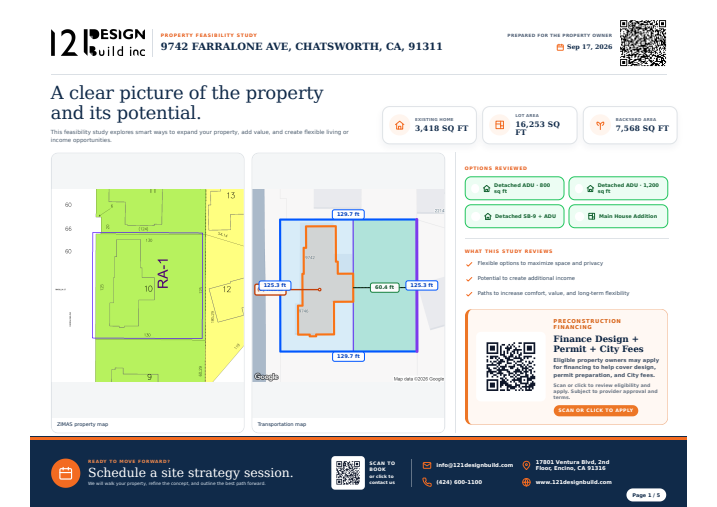
When 121 Design Build prices an ADU, the estimate is built line by line from these items. That breakdown is useful at renewal because it gives you a documented number for what the ADU actually cost, or would cost, to build. You can compare it with the insurer's replacement cost estimate and ask where the differences come from. If the insurer's figure is much lower, you can ask them to review it with the details in hand.
A construction estimate is not the same thing as an insurance valuation. It does not include the insurer's rules on depreciation, deductibles, policy exclusions, or limits. Your insurer or a licensed broker decides how the policy responds. The breakdown just helps you ask better questions.
What should I ask my insurer and my builder?
Questions for your insurer or broker:
- Do you know there is an ADU on my lot, and is it rated as part of the dwelling, as an other structure, or as a separate dwelling?
- What square footage, construction type, and features did you use for my replacement cost estimate, and does it include the ADU?
- What percentage of extended replacement cost do I have now, and does it apply to the ADU?
- How much building code upgrade coverage do I have, and does it apply to the ADU?
- If I rent the ADU, does my policy cover loss of rent and landlord liability?
- When will I get an updated rebuild cost estimate, and what happens under SB 876 once it is operative?
Questions for your design-build firm:
- Can you give me a line-item cost breakdown for the ADU, including labor, materials, permits, and code-driven items?
- Who carries builder's risk coverage during construction, you or me, and what does it cover?
- Can you give me a completion package with the final permit sign-off, square footage, and finishes so I can update my insurer?
- If the ADU had to be rebuilt to today's code, what items would cost more than the original build?
When should I notify my insurer about the ADU?
Timing is part of planning. Talk to your insurer or broker at each of these points:
- Before construction starts. Tell your insurer about the project. Confirm who carries builder's risk coverage, whether your homeowner policy has any limits on construction activity, and what liability coverage the builder carries. Ask your builder for certificates of insurance.
- During construction. Keep builder's risk in place until the project is complete, and let your insurer know about any major change in scope, such as converting from a garage conversion to a new detached ADU.
- At completion. Once LADBS signs off, send your insurer the details: square footage, construction type, finishes, and the final cost. Ask them to update your dwelling or other structures limit and your replacement cost estimate.
- At each renewal. Review the updated estimate. Compare it with your builder's cost breakdown and current construction costs. If you are renewing in 2027, ask how SB 876 will apply to your next renewal after the 2028 operative date.
How can 121 Design Build help?
121 Design Build Inc. is a design-build firm based in Encino that handles ADUs, additions, and remodels across Los Angeles. Because we design, permit, and build in one team, we can give you a single, line-item cost breakdown that reflects current Los Angeles labor and material pricing, LADBS permit requirements, and the code items that would apply to a rebuild. Owners use that breakdown to plan their budget, and many also share it with their insurer or broker when they check their coverage.
We can help you:
- Scope and price a new detached ADU, attached ADU, or garage conversion in Encino and across LA
- Provide a written cost breakdown you can compare with your insurer's replacement cost estimate
- Coordinate builder's risk and certificates of insurance during construction
- Deliver a completion package with LADBS sign-off details, square footage, and finishes for your insurer
Call (424) 600-2100, email info@121designbuild.com, or visit 121designbuild.com. Our office is at 17801 Ventura Blvd, 2nd floor, Encino, CA 91316.
FAQ
Does SB 876 require me to buy 50 percent extended replacement cost coverage?
No. Under the bill text, the insurer must offer it for eligible properties when it issues or renews a policy. You can decline it, and the insurer must record that you declined.
When does SB 876 actually apply to my policy?
The Department of Insurance says the law takes effect January 1, 2027, but the bill text makes its provisions operative January 1, 2028. Ask your insurer or broker how it applies to your specific renewal date.
Does the 50 percent offer cover my detached ADU?
The final bill text ties the offer to the policy limits for the primary dwelling. If your detached ADU is insured under other structures coverage, it may not be included. Ask your insurer how your ADU is classified and whether your extended coverage applies to it.
Will my insurer automatically know I built an ADU?
Do not assume so. A permit record does not necessarily update your policy. Tell your insurer when construction starts and send the completion details once LADBS signs off.
Can a contractor's estimate replace my insurer's replacement cost estimate?
No. A construction estimate is a real-world reference point, not an insurance valuation. It can help you and your insurer find gaps, but the policy terms and the insurer's valuation decide what is covered.
Who pays for builder's risk insurance on an ADU project?
It depends on the contract. Sometimes the owner buys it and sometimes the builder does. Agree on it in writing before work starts, and confirm what it covers, such as materials on site and work in progress.
Is Encino under LADBS or Los Angeles County?
Encino is part of the City of Los Angeles, so ADU permits and inspections go through LADBS.
Sources
- California Legislative Information: SB 876, Fire and residential property insurance (Chapter 656, Statutes of 2026)
- California Department of Insurance: Governor signs Commissioner Lara and Senator Padilla's Disaster Recovery Reform Act into law
- Insurance Business: California mandates bigger rebuild cushions as voters demand the right to sue insurers (October 8, 2026)
- Assembly Insurance Committee: SB 876 (Padilla) bill analysis, June 2026
- Senator Steve Padilla: Governor signs Senator Padilla's insurance claims reforms into law
- LADBS: Accessory Dwelling Unit (ADU)
This article is general information about California law and construction planning as of October 10, 2026. It is not legal or insurance advice. Talk to your insurer, a licensed insurance broker, or an attorney about your policy and property.
#EncinoADU #ADUInsurance #SB876 #ReplacementCost #RebuildCost #ExtendedReplacementCost #LosAngelesADU #LADBS #DesignBuild #121DesignBuild
Browse Our Related Articles & Blogs
Dive into a wide range of blog posts featuring the latest projects, creative design ideas and innovative sustainable practices. Stay informed with expert industry updates that shape the future of construction.


Frequently Asked Questions
Can’t find the answer you’re looking for? Please contact with our customer service.
Can’t find the answer you’re looking for? Please contact with our customer service.
Ready to build Smarter?
Book your free consultation today and discover how quickly we can turn your ideas into permits and long-term property value. Our team is here to guide you from the first sketch to final approval.