Los Angeles ADU Law Changes 2026: What to Know

Quick answer: Los Angeles ADU law changes 2026 mainly come from SB 543, AB 1154, the 2025 Title 24 Energy Code, and LA’s updated ADU permitting guidance. For LA homeowners, the biggest practical changes are a new 15-business-day completeness clock for ADU and JADU applications, clearer JADU owner-occupancy rules, interior-livable-space measurements, and new 2025 code compliance for permit applications filed on or after January 1, 2026.
An accessory dwelling unit, or ADU, is a secondary residential unit on the same lot as a primary home, while a junior ADU, or JADU, is a smaller unit created within a single-family residence or attached garage.
Key Takeaways
- SB 543 was approved on October 10, 2025 and became effective January 1, 2026, adding a 15-business-day completeness review requirement for ADU and JADU applications.
- Completed ADU applications for lots with existing single-family or multifamily dwellings must still be approved or denied within 60 days, and a completed ADU application is deemed approved if the local agency misses that deadline.
- AB 1154 changed JADU owner-occupancy: it is required only when the JADU shares sanitation facilities with the existing structure.
- Projects with building permit applications filed on or after January 1, 2026 must account for the 2025 California Energy Code, Title 24, Part 6.
- In Los Angeles, pre-2020 unpermitted ADUs and JADUs may have a legalization path under AB 2533 and LADBS guidance, but owners still need permits, inspections, evidence, and health-and-safety review.
What are the Los Angeles ADU law changes 2026 homeowners need to know?
The Los Angeles ADU law changes 2026 homeowners should know are not one single rule; they are a group of state and local updates that affect application timing, JADU design, code compliance, and legalization strategy. The most important state law is SB 543, which amended multiple Government Code sections governing ADUs and JADUs.
SB 543 changed several practical details. It requires permitting agencies to determine whether an ADU or JADU application is complete within 15 business days, requires written notice if items are missing, prevents the agency from adding new completeness items later that were not listed, and creates an appeal process for incomplete or denied applications. For ADUs, Government Code Section 66317 continues to require approval or denial within 60 days after a completed application is received, and the application is deemed approved if the local agency does not act on time.
The law also clarifies size terminology. SB 543 revises several measurements to refer to interior livable space, including the JADU cap of no more than 500 square feet of interior livable space and state minimum protected ADU sizes of 850 square feet for a studio or one-bedroom ADU and 1,000 square feet for an ADU with more than one bedroom. For tight Los Angeles lots, that wording matters because wall thickness and livability calculations can affect plan strategy.
How do Los Angeles ADU law changes 2026 affect permit timelines?
The 2026 changes should make the front end of LA ADU permits more accountable, but they do not eliminate the need for complete, code-coordinated drawings. A city can still deny an application that is defective or deficient, but it must return a full written set of comments and explain how the applicant can remedy the issues.
For homeowners, the practical lesson is simple: the clock helps only if the submittal is ready. Site plans, structural drawings, Title 24 documentation, grading or hillside information, fire separation details, utility coordination, and existing-building records can still drive the actual schedule. In Los Angeles, hillside properties, narrow lots, garage conversions, and older structures often need more documentation before LADBS can issue a clean approval.
LADBS also maintains an ADU information page and a Standard Plan Program. Standard plans can shorten plan check when the plan actually fits the site, but LADBS still reviews property-specific zoning, foundation, and site conditions. For many LA homeowners, especially in Encino, Sherman Oaks, Studio City, West LA, Venice, Silver Lake, and hillside neighborhoods, a custom ADU design may be more reliable than forcing a standard plan onto a complicated parcel.
What changed for JADU owner occupancy in Los Angeles?
AB 1154 narrowed the JADU owner-occupancy rule beginning January 1, 2026. Under amended Government Code Section 66333, owner-occupancy is required when the JADU shares sanitation facilities with the existing structure; owner-occupancy is not required if the JADU has separate sanitation facilities or if the owner is a governmental agency, land trust, or housing organization.
This is a meaningful design decision, not just a legal detail. A JADU with a shared bathroom may be cheaper and easier to fit inside an existing home, but it can carry an owner-occupancy requirement. A self-contained JADU with its own bathroom may offer more rental and ownership flexibility, but it requires more careful planning for plumbing, ventilation, egress, privacy, and construction cost.
JADUs still remain different from full ADUs. They are generally limited to one per qualifying single-family residential lot, must be within the proposed or existing single-family residence or attached garage, require an efficiency kitchen, require a separate entrance, and must be rented for terms longer than 30 days. That makes JADUs useful for some Los Angeles homeowners, but not a substitute for every backyard cottage or detached ADU strategy.
How does the 2025 Title 24 Energy Code affect LA ADU projects?
The 2025 California Energy Code affects LA ADU projects because buildings with permit applications filed on or after January 1, 2026 must comply with the 2025 Energy Code, also known as Title 24, Part 6. The California Energy Commission states that the 2025 Energy Code expands heat pump use, encourages electric-readiness, strengthens ventilation standards, and applies to new buildings and covered additions or alterations.
For a new detached ADU, this can affect HVAC, water heating, insulation, windows, lighting, solar photovoltaic design, electrical load planning, and compliance documentation. The CEC’s ADU FAQs also explain that new solar PV modules may be added to an existing solar system on the same lot to satisfy PV requirements for a newly constructed detached ADU, subject to Energy Code sizing and utility limitations.
Conversions need a closer reading. The CEC explains that converting existing conditioned space, such as a basement, into an ADU or JADU is generally treated as an alteration, and Energy Code requirements may be triggered by the components being altered, such as a new water heater, mini-split HVAC, lighting, or envelope work. In Los Angeles, early coordination between architecture, energy modeling, structural scope, and construction pricing is the safest way to avoid late plan-check revisions.
Can Los Angeles homeowners legalize an old unpermitted ADU?
Los Angeles homeowners may have a path to legalize certain pre-2020 unpermitted ADUs or JADUs under AB 2533 and Government Code Section 66332, but it is not automatic approval. HCD’s March 24, 2026 technical assistance letter to the City of Los Angeles states that AB 2533 provides a path to approval for unpermitted ADUs created before January 1, 2020, and that local agencies generally cannot deny a permit solely because the unit violates ADU rules or building standards unless correction is necessary under health-and-safety standards.
LADBS has also issued a 2026 bulletin for accessory and junior accessory dwelling units. The bulletin states that owners seeking to permit an unpermitted ADU or JADU built before January 1, 2020 should provide evidence such as RSO registration, contractor bills, utility bills, insurance documents, code enforcement records, leases, real estate documents, or other acceptable documentation.
This can be valuable for Los Angeles homeowners who inherited a garage conversion, guesthouse, converted recreation room, or informal rental unit. But legalization still requires plans, permits, inspections, and correction of health-and-safety issues. In practice, the first step should be a records review and feasibility assessment before opening a permit case that could reveal structural, egress, fire, electrical, plumbing, or tenant-occupancy issues.
How should LA homeowners plan an ADU under the 2026 rules?
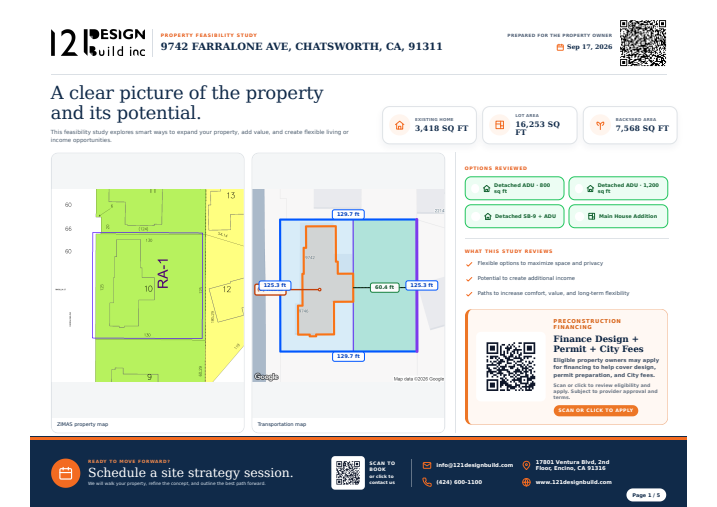
LA homeowners should begin with a property-specific feasibility study before selecting a floor plan or construction budget. State law may protect the right to build many ADUs, but the buildable solution still depends on lot geometry, existing structures, sewer location, fire separation, hillside conditions, power capacity, parking access, protected trees, and whether the project is new construction, conversion, or legalization.
For a detached ADU, the design team should test setbacks, height, daylight, privacy, fire-rated walls, foundation approach, Title 24 strategy, and utility routing. For a garage conversion ADU, the key issues are usually foundation adequacy, slab moisture, wall and roof framing, ceiling height, insulation, egress, sewer connection, and whether existing work can remain. For a JADU, the central design question is whether a separate bathroom is worth the added cost because it may remove the owner-occupancy requirement.
The 2026 laws reward clean documentation. A complete submittal can make the new 15-business-day completeness rule and 60-day ADU decision clock more useful. An incomplete submittal, by contrast, can still lead to correction cycles, appeal questions, and construction repricing.
How can 121 Design Build help with LA ADU permits and construction?
121 Design Build helps Los Angeles property owners evaluate ADU, JADU, conversion, addition, and multi-unit strategies from design through construction. For homeowners focused on rental income, family housing, or property value, our ADU & JADU service is the most direct fit because it integrates feasibility, permit-ready drawings, code coordination, and build planning.
If the best solution is not a detached unit, our Addition & Remodel team can evaluate whether a JADU, interior conversion, garage conversion, or primary-home expansion is more practical. For larger property strategies, SB9 and New Construction planning may help owners compare ADUs against lot-split, second-unit, or ground-up development options.
The value of a design-build approach is that permitting decisions are tested against construction realities early. If you are considering an ADU in Los Angeles under the 2026 rules, contact 121 Design Build at our contact page or call (424) 600-2100 to discuss feasibility before you commit to a plan set.
Frequently Asked Questions
What is the most important 2026 California ADU law for Los Angeles homeowners?
SB 543 is the most important 2026 ADU law for most Los Angeles homeowners because it adds a 15-business-day completeness review requirement and strengthens written correction and appeal procedures. It also clarifies several ADU and JADU measurements as interior livable space.
Does the 2026 law mean LADBS must approve every ADU in 60 days?
No. For qualifying ADU applications on lots with existing dwellings, the agency must approve or deny a completed application within 60 days, and the application is deemed approved if the agency misses that deadline. The city can still require code-compliant plans and can deny an application with written comments explaining the deficiencies.
Do JADUs still require the owner to live on the property?
Sometimes. Starting January 1, 2026, AB 1154 requires owner-occupancy only when the JADU shares sanitation facilities with the existing structure. If the JADU has separate sanitation facilities, state law does not require owner-occupancy under that provision.
Do 2026 ADUs in Los Angeles need to comply with Title 24?
Generally, yes. Permit applications filed on or after January 1, 2026 must account for the 2025 California Energy Code where applicable. The exact requirements depend on whether the project is a new detached ADU, an addition, an alteration, a conversion, or a legalization project.
Can I legalize a garage conversion built before 2020?
Possibly. AB 2533 and LA’s 2026 LADBS guidance create a path for certain unpermitted ADUs and JADUs built before January 1, 2020, but owners must provide evidence, submit plans, obtain permits, and correct health-and-safety issues. A feasibility review should come before permit filing.
Sources
- California Legislative Information: SB 543, Accessory dwelling units and junior accessory dwelling units
- California Legislative Information: AB 1154, Junior accessory dwelling units
- California HCD: March 24, 2026 Los Angeles ADU technical assistance letter
- California Energy Commission: 2025 Building Energy Efficiency Standards
This article is general information from a design-build and permitting perspective and is not legal advice.
#LosAngelesADU #ADULaw #LADBS #JADU #Title24 #SB543 #AB1154 #ADUPermits #GarageConversion #LAHomeowners #DesignBuild #Encino
Browse Our Related Articles & Blogs
Dive into a wide range of blog posts featuring the latest projects, creative design ideas and innovative sustainable practices. Stay informed with expert industry updates that shape the future of construction.


Frequently Asked Questions
Can’t find the answer you’re looking for? Please contact with our customer service.
Can’t find the answer you’re looking for? Please contact with our customer service.
Ready to build Smarter?
Book your free consultation today and discover how quickly we can turn your ideas into permits and long-term property value. Our team is here to guide you from the first sketch to final approval.