SB 1117 Is Now Law: Should Your Encino ADU Be 750 or 1,000 Square Feet? Impact-Fee Math and Timing Before January 2027


SB 1117 Is Now Law: Should Your Encino ADU Be 750 or 1,000 Square Feet? Impact-Fee Math and Timing Before January 2027
Quick answer: SB 1117 is now law. Governor Newsom approved it on September 29, 2026, and it was chaptered the same day as Chapter 809, Statutes of 2026. It amends Government Code Section 66311.5 and takes effect January 1, 2027. The 750 square-foot line still matters: an ADU with 750 square feet or less of interior livable space, or a JADU with 500 square feet or less, pays no impact fees. What changes is the penalty for going over. For up to two ADUs on a lot, impact fees on an ADU over 750 square feet are charged proportionately to the primary dwelling and only on the area in excess of 750 square feet. A 1,000 square-foot ADU is no longer fee-assessed as 1,000 square feet. It is assessed on 250. For many Encino families, that turns the decision from "stay under 750 at any cost" into "size the unit for how you will live in it, then time the fee assessment." Before January 1, 2027, the older whole-unit rule still applies. Ask LADBS, and every other agency that charges you, when your fee is calculated and collected before you decide to submit now or wait.
We covered this bill earlier, while it was still waiting on the Governor, in SB 1117 Unsigned: Keep Your Encino ADU Under 750 Square Feet in 2026. That post was accurate when it was written, in August 2026, but the advice has changed. This post replaces it with the signed-law view.
Definitions You Need Before the Math
An accessory dwelling unit (ADU) is an attached or detached dwelling with complete independent living facilities (living, sleeping, eating, cooking and sanitation) on the same lot as a proposed or existing primary residence (Government Code Section 66313). A junior accessory dwelling unit (JADU) is a unit of no more than 500 square feet contained entirely within a single-family residence. Interior livable space is the measurement the fee section uses. It is space intended for human habitation, so it is not the same as your gross footprint, roof area or patio. An impact fee in Section 66311.5 means a development fee under the Mitigation Fee Act (Section 66000) plus park fees under the Quimby Act. It does not include utility connection fees or capacity charges, which are handled separately in the same section. Proportionate to the primary dwelling means the agency scales its fee by the ratio of ADU square footage to the square footage of the main house, instead of charging a flat new-home rate. SB 1117 is Senator Sabrina Cervantes's 2025-26 bill. It adds the words "and only on the area in excess of 750 square feet of interior livable space" to that proportional rule for the first two ADUs on a lot.
Key Takeaways
- SB 1117 was approved by the Governor and chaptered on September 29, 2026 (Chapter 809, Statutes of 2026). It has no urgency clause, so it takes effect January 1, 2027.
- No change at the low end: an ADU of 750 sf or less of interior livable space, or a JADU of 500 sf or less, still pays no impact fees.
- The big change: for up to two ADUs on a lot, fees on an ADU over 750 sf are charged proportionately and only on the area above 750 sf.
- A third or later ADU on the same lot does not get the excess-only treatment. CA YIMBY's summary says those are assessed on the whole unit.
- The law reaches charter cities, including Los Angeles. The Legislature declared it a matter of statewide concern.
- Before January 1, 2027, an oversize ADU is still assessed under the older whole-unit proportional rule. The date your fee is actually calculated is what to confirm.
- Connection fees and capacity charges are a separate track and SB 1117 does not erase them. Ask your water and sewer providers about them separately.
- Do not plan around dollar amounts from a blog, including this one. Get your actual rates from the agencies that charge them on your parcel.
What Exactly Did SB 1117 Change?
Before SB 1117, Section 66311.5 already exempted small units. No local agency, special district or water corporation could impose an impact fee on an ADU with 750 square feet or less of interior livable space. Above that line, fees had to be charged proportionately in relation to the square footage of the primary dwelling. In practice, a unit at 751 square feet could be assessed on all 751 square feet. That jump is the fee cliff our August post told you to stay under.
The chaptered text keeps the exemption in subsection (c)(1)(A) and expands it to name JADUs of 500 square feet or less. Subsection (c)(1)(B) now reads, in substance: for up to two accessory dwelling units on a lot, any impact fees charged for an ADU with more than 750 square feet of interior livable space shall be charged proportionately in relation to the square footage of the primary dwelling unit, and only on the area in excess of 750 square feet of interior livable space. Beyond two ADUs on a lot, the older proportional rule applies to the whole unit. CA YIMBY describes the result as a switch from a cliff to a marginal fee structure.
Should Your Encino ADU Be 750 or 1,000 Square Feet?
Under the old rule, the 750 line was a hard wall. Going to 1,000 square feet meant a fee on all 1,000. Under SB 1117, going to 1,000 square feet means a fee on 250. That is one quarter of what the old rule charged on the same unit, before any other variable. The cliff is now a ramp.
So the real question is no longer "how do I avoid the fee?" It is "is the extra 250 square feet worth its whole cost?" The impact fee on 250 square feet is now one of the smaller pieces of that answer. The larger pieces are usually:
- Construction cost. Every added square foot is framed, roofed, insulated, finished and inspected. On most projects this is the largest cost of going bigger, far ahead of the fee.
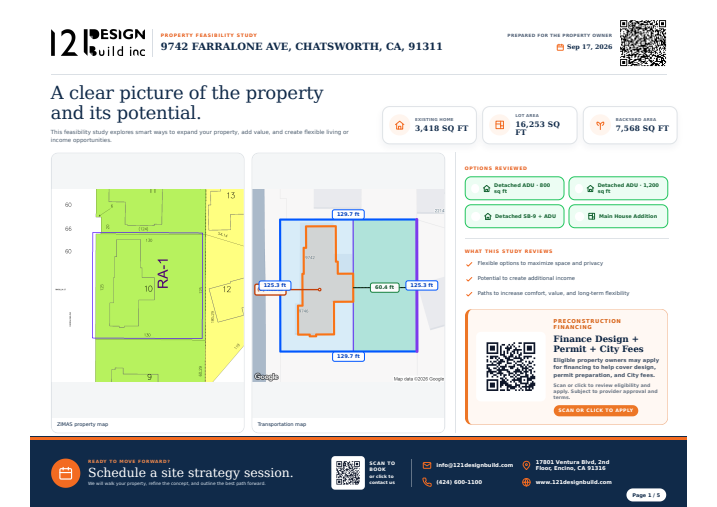
- Lot fit. Setbacks, height, lot coverage, protected trees, easements, hillside rules and fire-zone rules can decide the size before money does. Check your parcel in ZIMAS.
- Bedroom count and use. A 750 sf unit often works as a one-bedroom or a tight two-bedroom. A unit near 1,000 sf more easily holds two real bedrooms and a second bath, which matters for a parent who needs a caregiver, an adult child with a family, or a long-term rental aimed at households instead of singles.
- Other fees and charges. Plan check and permit fees, school fees, and utility connection or capacity charges each follow their own rules. Some scale with area and some do not. SB 1117 changes only the impact-fee line.
- Two-ADU plans. If you may build a second ADU later, size them together. The excess-only rule covers up to two ADUs on a lot, so a third unit changes the math.
A simple rule of thumb: if the extra rooms change how the unit lives (a second bedroom, a real dining area, an accessible bath), the new law makes 900 to 1,000 square feet far easier to justify than it was in August. If the extra area is just a bigger version of the same rooms, 750 is still the efficient choice, because it stays fully exempt from impact fees.
How Does the Fee Math Work? (Placeholder Rates Only)
We will not quote City of Los Angeles fee dollars here. Rates differ by fee type, are updated on their own schedules, and some agencies may revise schedules to match SB 1117. Use the logic below and plug in the real rate from your agency. Every rate in this section is a labeled placeholder, not an actual fee.
Agencies apply "proportionately" in different ways. One common approach scales a per-home fee by the ratio of ADU area to house area. Assume, for illustration only, a 2,000 sf house and a placeholder full-home fee of F.
- ADU at 750 sf, either rule: fee = 0. The exemption applies.
- ADU at 1,000 sf, old rule (before Jan 1, 2027): fee = F x (1,000 / 2,000) = 0.50 x F.
- ADU at 1,000 sf, SB 1117 rule (on or after Jan 1, 2027, first two ADUs): fee = F x (250 / 2,000) = 0.125 x F.
- ADU at 900 sf, SB 1117 rule: fee = F x (150 / 2,000) = 0.075 x F.
- ADU at 800 sf, SB 1117 rule: fee = F x (50 / 2,000) = 0.025 x F.
The pattern holds whatever F is: for a 1,000 sf unit, the SB 1117 base is one quarter of the old base (250 vs 1,000 square feet). If your agency uses a per-square-foot rate instead (call it placeholder P per sf, already adjusted for proportionality), the same unit is P x 1,000 under the old rule and P x 250 under the new rule. Your actual fee could be calculated differently. Ask the agency to show its formula on your own numbers.
Two cautions. First, make sure everyone is measuring interior livable space, the same way, on the same plan set. A design that reads 760 sf to one person and 748 sf to another is a real-money disagreement under the old rule and a smaller one under the new rule. Second, the math above ignores connection fees, capacity charges, school fees and plan check, which SB 1117 does not reduce.
Does Timing Before January 1, 2027 Matter?
Yes, for any ADU over 750 square feet. Until January 1, 2027, the pre-SB 1117 version of Section 66311.5 is the law, and an oversize ADU can be assessed proportionately on its whole interior livable area. On and after January 1, 2027, the first two ADUs on a lot are assessed only on the excess. For an ADU of 750 sf or less, timing makes no difference to impact fees, because it is exempt under both versions.
What decides which rule applies to you is when your fee is calculated and collected, not when you first had the idea. Agencies do not all assess at the same step. Some fees are computed at plan check, some are collected at permit issuance, and some providers bill at connection. We are not going to guess which applies to each fee on your parcel. Ask LADBS and each other fee-charging agency in writing: "On what date is this fee calculated, and if my permit issues after January 1, 2027, will it be assessed under the amended Section 66311.5?"
A practical way to think about it for an ADU between 750 and 1,000 square feet:
- Keep designing now. Survey, design, structural, Title 24 energy work and plan check take time. Doing them in late 2026 is rarely wasted.
- Do not rush fee payment for an oversize unit. If paying in December locks in the old whole-unit base, waiting a few weeks may be cheaper. Confirm first.
- Do not shrink to 750 only because of a fee you may not pay. The August reason to stay under 750 was a cliff that may not apply to you by the time you pay.
- Watch for refunds or adjustments only through the agency. If you already paid under the old rule, ask the agency directly whether anything applies. Do not assume a refund.
- Weigh carrying cost. If waiting delays rent or a family move-in by months, that cost may outweigh the fee savings. Run both sides.
Does SB 1117 Apply in Encino and the City of Los Angeles?
Encino is part of the City of Los Angeles, a charter city. The bill states that ADU fee rules are a matter of statewide concern rather than a municipal affair, so it applies to all cities, including charter cities. Any local schedule that conflicts with amended Section 66311.5 must give way on and after January 1, 2027. If a fee sheet you are handed in 2027 still charges an oversize ADU on its full area, point to the chaptered text and ask for review.
SB 1117 does not change ADU size limits, setbacks, height or the ministerial approval process. It changes how impact fees are calculated. Your design still has to fit the zoning and building rules on your lot.
Who Should You Hire for a 750 vs 1,000 Square-Foot Decision?
This decision mixes law, design and cost, so the person you hire should be able to handle all three in one plan. A useful team, whether it is one firm or several:
- Designer or architect who draws both a 750 sf and a larger option early, measures interior livable space consistently, and checks each against your parcel's zoning.
- Licensed general contractor who prices both options from those drawings, so the added construction cost is real and not a rule of thumb.
- Permit lead who confirms with LADBS and other agencies when each fee is calculated and builds the submittal timeline around the January 1, 2027 date.
- Structural and energy consultants as needed, coordinated by the lead so the numbers stay consistent.
- Your own tax, finance or legal advisors for rental, financing and estate questions, which are outside a builder's role.
Ask anyone you interview: Will you draw and price both sizes? How do you measure interior livable space? Who confirms fee timing with the agencies, and will I see it in writing? Splitting the work between an architect now and a contractor later can work, but it is easy to end up with a 950 sf design that nobody priced, fee line included.
How 121 Design Build Helps
121 Design Build handles ADU design, permitting and construction under one contract for homeowners in Encino and the rest of Los Angeles. For an SB 1117 sizing decision, we:
- Check your parcel and sketch a 750 sf option and a larger option that fit it.
- Measure interior livable space the same way on both, so the fee comparison is clean.
- Price construction for both sizes, so you can see the cost of the extra square feet next to the impact-fee change.
- Confirm with LADBS and other agencies when each fee is calculated, and plan your submittal around January 1, 2027.
- Carry the chosen design through plan check, permit and construction.
Call (424) 600-2100 to talk through your lot, or start from our Los Angeles ADU law changes 2026 overview.
FAQ
Is SB 1117 signed?
Yes. The Governor approved it on September 29, 2026, and it was chaptered as Chapter 809, Statutes of 2026. CA YIMBY's release about the signing was republished by ADU Journal on October 14, 2026.
When does SB 1117 take effect?
January 1, 2027. It has no urgency clause, so the regular effective date applies.
Do I still pay no impact fees at 750 square feet?
Yes. An ADU with 750 square feet or less of interior livable space pays no impact fees, and a JADU of 500 square feet or less pays none either. Other charges, such as plan check, permit, school, and some utility connection or capacity charges, follow separate rules.
If I build 1,000 square feet in 2027, what is my impact fee based on?
For one of the first two ADUs on your lot, it is based on the 250 square feet above 750, charged proportionately to your primary dwelling. The rate itself comes from your agency.
What about a third ADU on the same lot?
The excess-only rule covers up to two ADUs on a lot. Additional ADUs are assessed on the whole unit under the proportional rule.
Should I wait until 2027 to pull my permit?
If your ADU is over 750 square feet, maybe. Confirm when each fee is calculated and collected, then compare the fee savings against the cost of delay. If your ADU is 750 square feet or less, there is no impact-fee reason to wait.
Does SB 1117 reduce utility connection fees?
No. Section 66311.5 handles connection fees and capacity charges separately, and SB 1117's change is to the impact-fee calculation.
Was your earlier post wrong?
No, it was accurate when it was published. In August 2026 the bill was not yet law, and the advice was to plan under the rule in force. That rule now has an end date of December 31, 2026.
Sources
- California Legislative Information: SB-1117 Accessory dwelling units and junior accessory dwelling units (Chapter 809, Statutes of 2026)
- LegiScan: CA SB1117 enrolled text and status
- ADU Journal: Governor Newsom Signs Bill to Lower ADU Costs (CA YIMBY release, October 14, 2026)
- City of Los Angeles: ZIMAS parcel lookup
- 121 Design Build: SB 1117 Unsigned, earlier coverage (August 2026)
- 121 Design Build: Los Angeles ADU Law Changes 2026
This article is general information from a design-build and permitting perspective and is not legal advice. Fee formulas, rates and assessment timing vary by agency. Confirm them for your address with LADBS and each fee-charging agency, and consult a qualified attorney for legal questions.
#SB1117 #ADUFees #ImpactFees #EncinoADU #LosAngelesADU #ADU2027 #GovCode66311 #LADBS #DesignBuild #SanFernandoValley #121DesignBuild
Browse Our Related Articles & Blogs
Dive into a wide range of blog posts featuring the latest projects, creative design ideas and innovative sustainable practices. Stay informed with expert industry updates that shape the future of construction.
Frequently Asked Questions
Can’t find the answer you’re looking for? Please contact with our customer service.
Can’t find the answer you’re looking for? Please contact with our customer service.
Ready to build Smarter?
Book your free consultation today and discover how quickly we can turn your ideas into permits and long-term property value. Our team is here to guide you from the first sketch to final approval.