Pacific Palisades Rebuild Map: What Owners Should Know


Quick answer: The new Pacific Palisades rebuild map is a privately created, Palisadian-Post-hosted interactive tool that lets residents search parcels, view rebuild status, and follow permit and construction progress after the January 2025 Palisades Fire. For owners, the map is useful for neighborhood-level visibility, but it should not replace official LADBS, LA City Planning, or professional permitting guidance. The practical takeaway is simple: transparency is improving, but permit-ready architecture, verified site constraints, and complete submittals still determine how fast a rebuild moves.
The Pacific Palisades rebuild map is an informational parcel-level map that compiles public city and county records, including damage, debris-removal, permit, and inspection data, to visualize fire recovery progress over time.
What is the Pacific Palisades rebuild map?
The Pacific Palisades rebuild map is a searchable, interactive map that shows the neighborhood’s recovery parcel by parcel. According to the Palisadian-Post, the Pali Rebuild Map was created by Palisades native Kevin Pazirandeh and published on June 26, 2026, to help residents see permit status, construction progress, and estimated completion information for rebuilding lots.
The map is available through the Palisadian-Post and, according to the article, is updated continuously. Its own methodology page states that it compiles publicly available records from Los Angeles County, the City of Los Angeles, and LADBS, then applies its own estimates for rebuild progress and completion timing.
That distinction matters. The map is a strong public-facing visibility tool, not a permitting authority. Homeowners should use it to understand the broader pace of rebuilding, compare neighborhood activity, and identify whether public records appear to reflect their project accurately, but official decisions still come from LADBS, LA City Planning, and other reviewing agencies.
Why does the Pacific Palisades rebuild map matter for homeowners?
The Pacific Palisades rebuild map matters because it makes fragmented permit and construction information easier to see in one place. Before this kind of visualization, owners often had to search separate city, county, debris-removal, permit, and inspection resources to understand how the rebuild was progressing around them.
For a homeowner deciding whether to rebuild like-for-like, redesign, add an ADU, or coordinate construction financing, timing information is not abstract. The difference between a parcel in plan check, a parcel with an issued building permit, and a parcel approaching Certificate of Occupancy can affect insurance conversations, temporary housing decisions, contractor scheduling, and neighborhood expectations.
Still, the map should be read carefully. Its methodology notes that it tracks only new-construction “Bldg-New” permits for ground-up home rebuilds and does not count repair, ADU, pool, wall, and other permit types toward rebuild progress. That means an owner doing a complex repair, phased accessory work, or an ADU-first strategy may not see the full scope of activity reflected in the same way.
How does the Pacific Palisades rebuild map estimate completion dates?
The Pacific Palisades rebuild map estimates completion by using observed inspection milestones and typical remaining time to final inspection and Certificate of Occupancy. Its methodology says the estimate starts with the furthest-along inspection a home has passed, adds the typical remaining time to final inspection, then adds the typical time from final inspection to Certificate of Occupancy.
The map also discloses an “optimism adjustment,” extending projected remaining time because the earliest completed homes tend to represent the fastest builds. That is a useful caveat for owners: early rebuild data can make timelines look cleaner than they will be for hillside lots, Coastal Zone properties, constrained sites, insurance-delayed projects, or homes requiring utility coordination.
From a design-build perspective, a projected completion date is only as reliable as the underlying permit, inspection, procurement, and construction conditions. Site-specific issues such as soils, foundations, retaining walls, fire access, utility reconnection, bluff setbacks, and biological-resource review can materially change the schedule.
What changed in Los Angeles rebuild permitting after the Palisades Fire?
Los Angeles changed the rebuild process by creating emergency pathways intended to reduce discretionary delay for eligible fire rebuilds while preserving code, safety, and site-specific review. Mayor Karen Bass issued Emergency Executive Order 1 on January 13, 2025, later revised on March 18, 2025, to support expedited community rebuilding and recovery.
EO1 generally created a streamlined “like-for-like” pathway for eligible projects, commonly discussed as rebuilding within 110% of the previously existing height and footprint and in substantially the same location. The City’s recovery guidance says EO1 like-for-like projects are reviewed based on 110% of previously existing height and footprint, while projects outside that pathway may need other review depending on location and scope.
On July 23, 2025, Mayor Bass issued Emergency Executive Order 8 and a partial revision to EO1. EO8 expanded local streamlining for zoning-compliant, non-like-for-like single-family residential projects in the Coastal Zone, aligning with Governor Gavin Newsom’s July 7, 2025 Executive Order N-29-25, which expanded state-level CEQA and Coastal Act suspensions for certain rebuilds.
The current city framework is therefore more flexible than the initial post-fire pathway, but it is not a blanket permission to build anything anywhere. EO8 eligibility includes requirements such as single-family residential use, repair or replacement of substantially damaged or destroyed property, compliance with objective zoning standards, Coastal Zone location, replacement of the same number of units except allowable ADUs, no lot consolidation or subdivision, required bluff setbacks, and applicable environmental protection measures.
What does the Pacific Palisades rebuild map mean for permit strategy?
The Pacific Palisades rebuild map does not change permit rules, but it can help owners ask better permitting questions earlier. If nearby parcels are advancing faster, the reason may be a simpler scope, a complete submittal, a pre-approved plan, fewer hillside or Coastal Zone constraints, or a project that fits EO1 or EO8 cleanly.
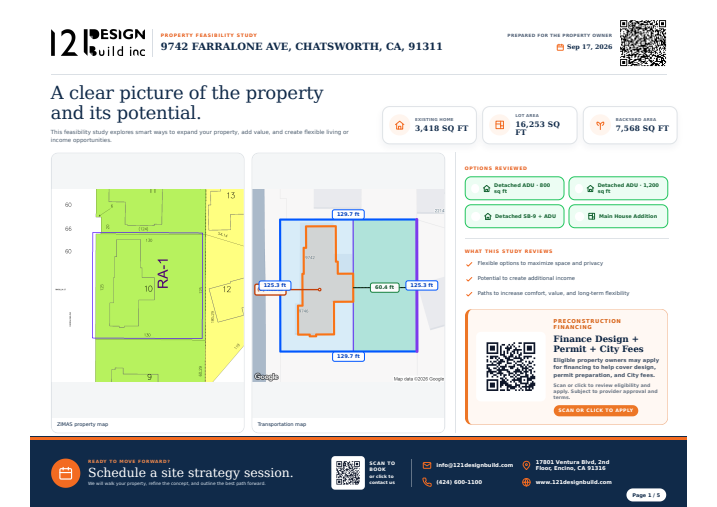
Owners should not assume that two properties on the same street have the same entitlement path. In Pacific Palisades, a parcel may be affected by Coastal Zone status, hillside conditions, prevailing setbacks, fire access, bluff potential, biological resources, prior nonconformities, ADU strategy, or whether the owner is rebuilding the same number of units. LA’s recovery guidance directs owners to use ZIMAS to check Coastal Zone and other parcel information, and to consult City Planning where special review may apply.
The fastest path is usually not the smallest design; it is the clearest design. A complete package that resolves zoning, code, site engineering, structural design, energy compliance, and fire-resilient construction details before submittal is more likely to move through review without repeated corrections.
How should owners use the Pacific Palisades rebuild map with official city tools?
Owners should use the Pacific Palisades rebuild map as a visibility layer, then verify project-specific decisions through official city systems. LADBS provides permit status tools, ePlanLA submission pathways, inspection resources, and wildfire rebuilding guidance, while LA City Planning provides Palisades Rebuild and Recovery information for zoning, Coastal Zone, and executive-order eligibility questions.
A practical workflow is to start with the map to understand public-facing parcel status, then check official LADBS records for permit details, then review ZIMAS and LA City Planning guidance for parcel constraints. If your records appear incomplete or inconsistent, address that before relying on the map for planning decisions.
For owners selecting pre-approved standard plans, LADBS states that all pre-approved plans still require final review for site-specific conditions and clearances before building permits can be issued. That means even a fast-track design must be adapted to the realities of the lot.
How can 121 Design Build help with a Pacific Palisades rebuild?
121 Design Build helps Los Angeles property owners turn rebuild visibility into permit-ready action. The firm’s role is to evaluate the parcel, define the most realistic entitlement path, coordinate design and construction requirements, and prepare documentation that can move through review efficiently.
For ground-up replacement homes, our New Construction service is the most direct fit. For owners who are repairing, reconfiguring, or expanding a partially damaged property, Addition & Remodel can help align the design with current code, site constraints, and long-term value.
Many Palisades owners are also evaluating whether an accessory dwelling unit should be rebuilt, added, or phased ahead of the main residence. Our ADU & JADU team can help assess state ADU rules, local requirements, Coastal Zone considerations, and construction sequencing. For damaged storefronts, offices, or mixed-use properties, our Commercial Architecture service supports code-compliant recovery planning.
If you are deciding whether to rebuild like-for-like, redesign under EO8, use a pre-approved plan, or pursue a custom permit-ready design, contact 121 Design Build for a focused feasibility conversation before you commit to a path.
Key Takeaways
- The Pacific Palisades rebuild map was published by the Palisadian-Post on June 26, 2026, and visualizes parcel-level rebuild status using public records and its own estimates.
- The map is helpful for transparency, but it is not an official LADBS or LA City Planning determination.
- EO1 supports eligible like-for-like rebuilds, while EO8 expanded streamlining for certain zoning-compliant, non-like-for-like single-family rebuilds in the Coastal Zone.
- Owners should verify Coastal Zone, hillside, bluff, biological-resource, and zoning conditions before relying on any projected timeline.
- Permit-ready design remains the key driver of speed: complete drawings, engineering, code compliance, and site documentation reduce correction cycles.
Frequently Asked Questions
Is the Pacific Palisades rebuild map an official city map?
No. The Pacific Palisades rebuild map is a Palisadian-Post-hosted informational project that compiles public records and applies its own methodology. Official permit and planning determinations still come from LADBS, LA City Planning, and other agencies.
Can I use the map to find out whether my permit has been approved?
You can use the map as a public-facing reference, but you should verify permit approval through LADBS permit status tools or your project team. Public datasets can lag, and the map itself disclaims guarantees about accuracy, completeness, and timeliness.
Does EO8 allow a larger rebuilt home in the Coastal Zone?
EO8 can provide a streamlined path for certain zoning-compliant, non-like-for-like single-family rebuilds in the Coastal Zone. Eligibility depends on specific criteria, including zoning compliance, unit count, bluff setbacks, environmental protections, and no lot consolidation or subdivision.
Do pre-approved plans eliminate all plan review?
No. LADBS says pre-approved standard plans can reduce review time, but each property still needs final review for site-specific conditions and clearances before a building permit is issued. Soil, foundation, zoning, fire access, and utility conditions can still require project-specific work.
What should I do before choosing a rebuild design?
Start with parcel due diligence: confirm zoning, Coastal Zone status, hillside conditions, fire access, setbacks, prior permits, and whether EO1 or EO8 may apply. Then work with a qualified architect or design-build team to prepare a complete, permit-ready package before submitting to LADBS.
Sources
- Palisadian-Post: New Interactive Map Lets Residents Track Palisades Rebuild
- Pali Rebuild Map methodology and disclaimers
- LA Strong: Return & Rebuild rebuilding guidance
- Mayor Bass Emergency Executive Orders
- LADBS wildfire rebuilding and pre-approved plans guidance
This article is general information from a design-build and permitting perspective and is not legal advice.
#PacificPalisades #PalisadesRebuild #LARebuild #LosAngelesArchitecture #DesignBuild #LADBS #WildfireRecovery #PermitReady #ADU #CoastalZone #HomeRebuild #121DesignBuild
Browse Our Related Articles & Blogs
Dive into a wide range of blog posts featuring the latest projects, creative design ideas and innovative sustainable practices. Stay informed with expert industry updates that shape the future of construction.


Frequently Asked Questions
Can’t find the answer you’re looking for? Please contact with our customer service.
Can’t find the answer you’re looking for? Please contact with our customer service.
Ready to build Smarter?
Book your free consultation today and discover how quickly we can turn your ideas into permits and long-term property value. Our team is here to guide you from the first sketch to final approval.