Los Angeles SB 79 Housing Law: Transit Density Rules


Quick answer: The Los Angeles SB 79 housing law is now operative as of July 1, 2026, allowing qualifying multifamily housing projects near major transit stops to use state-set height, density, and floor-area standards even where local zoning previously limited apartments. In Los Angeles, the biggest practical effect is not that every transit-adjacent single-family lot will change overnight, but that owners, developers, and design teams now have a new feasibility path for housing near Metro rail, light rail, and qualifying bus corridors. The City of Los Angeles has also adopted local phased-implementation and low-rise ordinances, so site-specific review through ZIMAS, SCAG mapping, and City Planning guidance is essential before assuming what can be built.
SB 79, formally the Abundant and Affordable Homes Near Transit Act, is a California housing law codified in Government Code sections 65912.155 through 65912.162 that creates statewide transit-oriented development standards for qualifying housing near specified transit stops.
What does the Los Angeles SB 79 housing law change?
The Los Angeles SB 79 housing law changes the starting point for entitlement analysis near transit: qualifying projects are treated as an allowed use on eligible residential, mixed-use, or commercial sites if they meet the statute’s requirements. The official bill text says the law applies to housing development projects within specified distances of transit-oriented development stops and establishes standards for height, density, and residential floor area ratio based on transit tier and proximity.
Before SB 79, local zoning, specific plans, overlays, and single-family zoning could often be the controlling barrier to multifamily housing near transit. SB 79 limits that barrier for eligible projects by tying development capacity to transit access rather than local zoning alone. That is why NBC Los Angeles described the law as opening more areas near transit hubs to apartments, including neighborhoods near Hollywood, Lankershim, Wilshire, Crenshaw, and Atlantic boulevards.
The law was signed by Governor Gavin Newsom on October 10, 2025, and became operative for local agencies on July 1, 2026, according to the California Department of Housing and Community Development. HCD also confirms that SB 79 is codified in Government Code sections 65912.155–65912.162 and that HCD oversees local compliance, including review of local ordinances and transit-oriented development alternative plans.
Which Los Angeles properties can use SB 79 near transit?
Eligible Los Angeles properties generally must be on sites zoned for residential, mixed-use, or commercial development and located near qualifying transit-oriented development stops in an urban transit county. HCD states that SB 79 makes qualifying transit-oriented housing developments an allowed use near specified transit stops in urban transit counties, and SCAG has identified Los Angeles County as the only urban transit county currently in its region.
Los Angeles City Planning’s SB 79 fact sheet says eligible projects must propose five or more housing units, be located on an eligible site near a TOD stop, and comply with affordability requirements, labor standards, and tenant-protection rules. The City also notes that SB 79 can apply broadly across residential, multifamily, commercial, and light manufacturing zones where residential uses are permitted.
Important exclusions remain. Los Angeles City Planning says SB 79 does not apply to projects that demolish more than two rent- or price-controlled units, including RSO units, that were occupied within the prior seven years. The City’s local phased implementation materials also identify sensitive categories such as very high fire hazard severity zones, certain sea-level-rise areas, local historic resources designated by January 1, 2025, and industrial employment hubs as areas requiring special attention or potential exclusion.
How tall can LA housing near transit be under SB 79?
SB 79 height depends on the transit tier and the site’s distance from the stop. Los Angeles City Planning’s fact sheet summarizes Tier 1 standards for heavy rail or very high-frequency commuter rail: up to 95 feet, roughly nine stories, within 200 feet; 75 feet, roughly seven stories, within a quarter-mile; and 65 feet, roughly six stories, within a half-mile.
For Tier 2 stops, including light rail, high-frequency commuter rail, bus rapid transit, and eligible bus-only-lane service, the City’s fact sheet lists up to 85 feet, roughly eight stories, within 200 feet; 65 feet, roughly six stories, within a quarter-mile; and 55 feet, roughly five stories, within a half-mile. Density and FAR also step down with distance: Tier 1 ranges from 160 to 100 dwelling units per acre and FAR 4.5 to 3.0, while Tier 2 ranges from 140 to 80 dwelling units per acre and FAR 4.0 to 2.5.
These numbers are not a substitute for parcel-level design analysis. Height, density, FAR, affordability set-asides, replacement-housing issues, labor requirements, fire access, utilities, parking strategy, and objective design standards can all affect whether a concept is actually permit-ready.
How is Los Angeles implementing SB 79 locally?
Los Angeles is using a phased local implementation strategy rather than relying only on automatic statewide standards. Los Angeles City Planning reports that the City Council directed a phased approach on March 24, 2026, the City Planning Commission recommended the first ordinances on May 14, 2026, and the City Council adopted the Low-Rise Ordinance and Phased Implementation Ordinance on June 23, 2026; both became effective June 30, 2026.
The City’s SB 79 page says the local approach is intended to implement SB 79 locally by 2030 while expanding the Corridor Transition program to single-family and lower residential parcels and extending incentives to half-mile buffers around eligible transit stations, excluding HPOZs. In plain English, Los Angeles is attempting to add local housing capacity near transit while pausing or redirecting some SB 79 effects where state law allows.
The related Low-Rise Ordinance expands missing-middle housing incentives through the City’s Mixed Income Incentive Program. City Planning describes eligible building types as low-rise formats such as bungalow courts, row houses, townhomes, courtyard housing, and cottage-court apartments, with affordable-unit requirements and performance standards for open space, pedestrian access, and building entries.
What should LA owners and developers do before pursuing an SB 79 project?
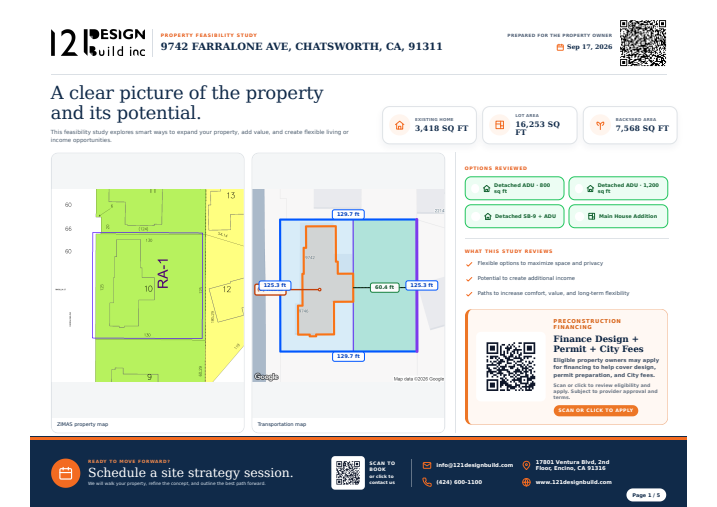
Owners and developers should start with a parcel-level feasibility screen, not a generic map view. SB 79 depends on the official SCAG transit-oriented development map, local ZIMAS information, the site’s zoning and overlays, distance to the transit stop, whether the stop is Tier 1 or Tier 2, affordability obligations, and whether any local phased-implementation exclusion applies.
SCAG says it is responsible for developing and maintaining the official SB 79 “Stops, Zones, and Tiers Map” for its region. Its June 2026 materials explain that the map identifies qualifying transit stops, TOD zones, and tier classifications, and that Los Angeles County is the only urban transit county in the SCAG region at this time.
From a design-build perspective, the key question is feasibility: can a code-compliant building mass, unit mix, circulation plan, fire/life-safety strategy, structural system, parking approach, and affordability program fit the lot and still pencil? Early architectural due diligence can prevent costly entitlement assumptions, especially on small lots, sloped sites, constrained corner parcels, and properties with existing rent-stabilized units.
How can 121 Design Build help with LA transit-oriented housing?
121 Design Build helps Los Angeles property owners and developers translate new housing rules into buildable, permit-ready concepts. For ground-up apartment or mixed-use opportunities near transit, our New Construction team can evaluate massing, unit count, FAR, construction approach, and permitting path early.
For projects that include restricted affordable units or pursue city and state housing incentives, our Affordable Housing / ED-1 service is often the closest fit. Owners evaluating smaller missing-middle opportunities, low-rise multifamily, or redevelopment of existing residential parcels may also need Addition & Remodel analysis or, where a smaller rental strategy is more appropriate, ADU & JADU planning.
The smartest next step is a targeted site assessment: address, zoning, transit tier, overlays, existing improvements, development goals, and budget. To discuss whether SB 79 or Los Angeles’ local low-rise incentives could apply to your property, contact 121 Design Build or call (424) 600-2100.
Key Takeaways
- SB 79 became operative for local agencies on July 1, 2026, after being signed on October 10, 2025.
- The law applies to qualifying housing projects near specified transit stops on eligible residential, mixed-use, or commercial sites.
- Los Angeles adopted local phased-implementation and low-rise ordinances on June 23, 2026, effective June 30, 2026.
- Tier 1 and Tier 2 standards can allow mid-rise multifamily housing near Metro and qualifying high-frequency transit, but site-specific exclusions still matter.
- Feasibility depends on more than height: affordability, tenant protections, labor rules, fire access, utilities, overlays, and construction economics must be reviewed early.
Frequently Asked Questions
Does SB 79 eliminate single-family zoning in Los Angeles?
SB 79 does not erase zoning maps, but it can override local limits for qualifying housing projects near eligible transit stops. Los Angeles has also adopted local ordinances that phase implementation and expand low-rise incentives in selected areas, so parcel-level review is required.
When did SB 79 take effect in Los Angeles?
SB 79 became operative for local agencies on July 1, 2026. Los Angeles adopted its local Low-Rise Ordinance and Phased Implementation Ordinance on June 23, 2026, and those ordinances became effective on June 30, 2026.
Can SB 79 projects be built by right?
SB 79 makes qualifying transit-oriented housing an allowed use, and the statute connects eligible projects to streamlined ministerial approval if they meet applicable legal requirements. However, a project still must satisfy objective standards, affordability rules, tenant protections, labor requirements, and any valid local implementation rules.
How do I know if my property is in an SB 79 zone?
Check the SCAG SB 79 Stops, Zones, and Tiers Map and the City of Los Angeles ZIMAS system, then confirm the parcel’s zoning, overlays, and local ordinance status. A professional feasibility review is recommended before purchasing, designing, or underwriting an SB 79 project.
Is SB 79 only for large apartment developers?
No, but the law generally applies to housing projects of five or more units and is most relevant to multifamily or mixed-use development. Smaller owners may find Los Angeles’ Low-Rise Incentive Area, ADU strategies, or other housing programs more practical depending on lot size and project goals.
Sources
- NBC Los Angeles: More apartments are coming to LA near transit hubs
- California Legislative Information: SB 79 bill text
- California HCD: SB 79 Transit-Oriented Development
- Los Angeles City Planning: Senate Bill 79
This article is general information from a design-build and permitting perspective and is not legal advice.
#SB79 #LosAngelesHousing #LADevelopment #TransitOrientedDevelopment #MultifamilyHousing #LAArchitecture #DesignBuild #HousingNearTransit #PermitReady #AffordableHousing #ZoningUpdate #MetroLA
Browse Our Related Articles & Blogs
Dive into a wide range of blog posts featuring the latest projects, creative design ideas and innovative sustainable practices. Stay informed with expert industry updates that shape the future of construction.


Frequently Asked Questions
Can’t find the answer you’re looking for? Please contact with our customer service.
Can’t find the answer you’re looking for? Please contact with our customer service.
Ready to build Smarter?
Book your free consultation today and discover how quickly we can turn your ideas into permits and long-term property value. Our team is here to guide you from the first sketch to final approval.