SB 1036 Fee Credit: Tearing Down and Rebuilding in Encino? How Credit for Your Old House Cuts LA Impact Fees, and Who to Hire


SB 1036 Fee Credit: Tearing Down and Rebuilding in Encino? How Credit for Your Old House Cuts LA Impact Fees, and Who to Hire
Quick answer
SB 1036 (Grayson) is now California law (Chapter 54, Statutes of 2026). It was approved by the Governor on June 30, 2026 and, as a non-urgency bill, takes effect January 1, 2027. It amends the Mitigation Fee Act (Government Code Section 66001) so that when a development project demolishes or changes an existing use, the local development impact fee must be offset to account for that existing use. The fee can then reflect only the project's incremental (added) impact on public facilities or services. For an Encino owner tearing down an older house and rebuilding, the practical message is simple: your old house counts. Plan the project, and its fee review, with a team that tracks these credits from day one.
Short definitions
- SB 1036: A 2026 California law that requires impact fees on redevelopment and change-of-use projects to be offset for the existing use being demolished or changed.
- Development impact fee: A one-time charge a local agency imposes as a condition of approving a project to help pay for public facilities such as parks, roads or utilities (defined under the Mitigation Fee Act, Government Code Section 66000 and following).
- Fee credit (offset): A reduction in the fee for the impact the existing building already places on public services. Under SB 1036, an offset larger than the fee is not refundable and cannot be applied to another fee.
- Change of existing use: Under SB 1036, no demolition is proposed but the use inside an existing structure changes to a new use (adaptive reuse).
- Capacity charge: A water or sewer charge for connection capacity. SB 1036 also says that when an existing connection's capacity changes, the charge may cover only the change in capacity.
Key Takeaways
- SB 1036 is Chapter 54, Statutes of 2026, approved June 30, 2026, and effective January 1, 2027.
- It adds subdivision (h) to Government Code Section 66001: fees on projects that demolish or change an existing use must be offset so they cover only the incremental impact.
- It amends Government Code Section 66013 so water and sewer capacity charges for a changed connection reflect only the change in capacity, with no refund if capacity goes down.
- In Los Angeles, some fees already account for what exists on the lot: the park fee exempts one-for-one replacement of dwelling units and ADUs, and the Affordable Housing Linkage Fee exempts ADUs and single-family projects that add 1,500 net square feet or less.
- Under state law, ADUs with 750 square feet or less of interior livable space are exempt from impact fees.
- Fee outcomes depend on project scope, timing and each agency's rules, so get a fee review before you finalize the design.
What exactly does SB 1036 change?
Before SB 1036, the Mitigation Fee Act already required a reasonable relationship between a fee and the impact of the development. SB 1036 makes the existing-use credit explicit. The new Government Code Section 66001(h) says that if a development project demolishes or changes an existing use, the amount of a fee imposed on the project shall be offset to account for the demolition or change, so the fee is attributable only to the project's incremental impact on public facilities or services. Two limits apply: an offset larger than the fee is not refundable or usable against any other fee, and a change of use means the structure stays but the use inside it changes.
The bill also amends Government Code Section 66013 for water and sewer. When a change in the capacity of an existing water or sewer connection is proposed, the agency may calculate the capacity charge only on the change in capacity. If the existing capacity is larger than the proposed capacity, nothing is refunded or credited toward other charges.
SPUR, one of the bill's sponsors, summarized it with a simple example: if an old store becomes housing, the project should not pay as though it were developing an entirely new site.
When does SB 1036 take effect, and does it apply to my permit?
SB 1036 was approved by the Governor and filed with the Secretary of State on June 30, 2026. It is a non-urgency bill, so under the normal California rule it takes effect January 1, 2027. If your fees are being calculated now, ask the city and any other fee-charging agency how they treat existing-use credits today and whether timing your fee assessment matters. Do not assume the new rule applies to fees already imposed.
How does Los Angeles already handle fees on a single-family tear-down rebuild?
Los Angeles charges several different fees, and each has its own rules. Here is what the City's own codes and guidance say about the most common ones:
- Park fee (LAMC Section 12.33, Quimby and park mitigation fees): Applies to net new dwelling units. Exemptions include alterations or expansions where no additional dwelling units are created, replacement of existing dwelling units on the same lot with no net increase in units, rebuilding a destroyed or damaged structure with no added units, and ADUs and JADUs. A one-house-for-one-house rebuild in Encino is generally exempt.
- Affordable Housing Linkage Fee (LAMC Section 19.18): Applies to development projects including additional single-family floor area. According to the Los Angeles Housing Department, single-family detached homes or additions resulting in 1,500 net square feet or less are exempt; floor area above that is also exempt if the home stays under the same ownership for three years from building permit issuance. If not exempt, all net new floor area added to the site is charged. ADUs are exempt. Note that the fee is calculated on the net increase, so floor area you remove counts.
- School fees: School districts, including LAUSD, may levy developer fees under Education Code Section 17620. For additions and other residential construction, the fee applies only when assessable space increases by more than 500 square feet. Confirm the current rate and how a full rebuild is measured directly with the district.
- Water and sewer capacity charges: SB 1036's change to Government Code Section 66013 limits capacity charges on a changed connection to the change in capacity.
The takeaway: LA already credits much of what stands on an Encino lot for park and linkage fees. SB 1036 adds a statewide rule that strengthens the existing-use credit across Mitigation Fee Act fees, which helps owners argue for a fair fee when a local schedule does not net out the old house.
What about adding an ADU instead?
Under Government Code Section 66311.5 (formerly Section 66324), a local agency, special district or water corporation may not impose any impact fee on an ADU with 750 square feet or less of interior livable space, or a JADU with 500 square feet or less. Larger ADUs may be charged impact fees only in proportion to the square footage of the primary dwelling. ADUs and JADUs under 500 square feet are not subject to school impact fees, according to the California Department of Housing and Community Development (HCD). In Los Angeles, ADUs are also exempt from the park fee and the Affordable Housing Linkage Fee. Utility connection fees and capacity charges are treated separately.
Tear-down rebuild, major remodel or ADU: which is right for an Encino lot?
- Tear-down rebuild: Best when the existing house has structural, layout or code problems that make remodeling inefficient. Fees depend on net new floor area and units; SB 1036 and LA's own exemptions credit what you demolish.
- Major remodel or addition: Keeps the existing structure. LA's park fee exempts alterations and expansions with no new units, and the linkage fee exemption for 1,500 net square feet or less often applies.
- ADU (alone or with a remodel): Often the lowest-fee way to add living space, with state exemptions at 750 square feet or less and LA exemptions for park and linkage fees.
Many Encino owners combine these: a remodel or rebuild of the main home plus a fee-exempt ADU. The right mix depends on your lot, zoning, hillside or fire-zone rules, budget and long-term plans.
Who should you hire for a tear-down rebuild in Encino?
A tear-down rebuild touches demolition permits, new construction plans, plan check, and several fee agencies. The most common and costly mistake is splitting design and construction across teams that never talk about fees or permits until late. Look for:
- One combined design and permit team that runs the feasibility study, design, plan check and construction under one contract.
- Experience with LADBS plan check, LA City Planning rules, and hillside or fire-zone requirements common in Encino.
- A habit of documenting the existing house (square footage, units, uses) before demolition so existing-use credits can be claimed.
- Clear, written scope and fee assumptions before you commit to a design.
- A licensed California contractor; verify any license on the Contractors State License Board (CSLB) website.
How 121 Design Build can help
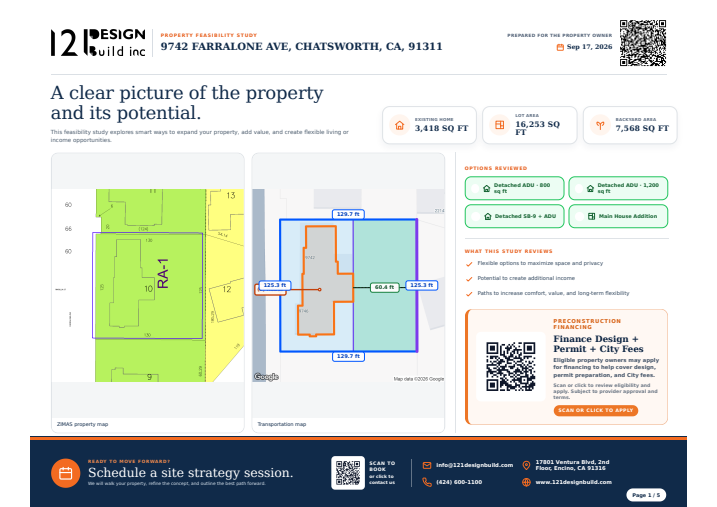
121 Design Build Inc. is an Encino-based design-build firm serving Los Angeles homeowners. We handle design, permitting and construction under one team, so fee questions like SB 1036 credits, linkage fee thresholds and ADU size limits are part of the plan from the start, not a surprise at permit issuance. We can help you compare a tear-down rebuild, remodel or ADU for your lot and prepare the documentation of your existing house that fee credits rely on.
Call (424) 600-2100 or visit our office at 17801 Ventura Blvd, 2nd floor, Encino, CA. Learn more at 121designbuild.com.
FAQ
Is SB 1036 law?
Yes. It is Chapter 54, Statutes of 2026, approved by the Governor on June 30, 2026.
When does SB 1036 take effect?
January 1, 2027, under the standard effective date for non-urgency California statutes.
Does SB 1036 eliminate impact fees on my rebuild?
No. It requires the fee to be offset for the existing use so you pay only for the added impact. If the offset is larger than the fee, the excess is not refunded or applied to other fees.
Does SB 1036 apply to adaptive reuse?
Yes. It covers projects that change an existing use, meaning no demolition is proposed but the use within an existing structure changes to a new use.
Do I pay LA park fees if I rebuild one house for one house?
Under LAMC Section 12.33, replacement of existing dwelling units on the same lot with no net increase in units is exempt from the park fee.
Is an ADU exempt from impact fees in Los Angeles?
Under state law, ADUs with 750 square feet or less of interior livable space are exempt from impact fees; larger ADUs may be charged proportionately. LA also exempts ADUs from the park fee and the Affordable Housing Linkage Fee.
Should I document my old house before demolition?
Yes. Records of existing square footage, units and use support fee credits and net-floor-area calculations.
Sources
- California Legislative Information: SB 1036 (Grayson), Mitigation Fee Act
- SB 1036 chaptered text, Chapter 54, Statutes of 2026
- SPUR: Newsom Signs Seven SPUR-Sponsored Bills (October 20, 2026)
- LAMC Section 19.18, Affordable Housing Linkage Fee
- LAHD: Affordable Housing Linkage Fee Background
- LA City Planning: Park Fee Ordinance Quick Guide
- Government Code Section 66311.5, ADU fees
- HCD Accessory Dwelling Unit Handbook (March 2026)
- Education Code Section 17620, school developer fees
- Contractors State License Board
This article is for general information only and is not legal advice. Fee rules and amounts change; confirm current requirements with the City of Los Angeles, LADBS, your school district and other fee-charging agencies, or consult an attorney, before making decisions.
#SB1036 #EncinoRebuild #LosAngelesImpactFees #TeardownRebuild #EncinoDesignBuild #ADU #LADBS #121DesignBuild
Browse Our Related Articles & Blogs
Dive into a wide range of blog posts featuring the latest projects, creative design ideas and innovative sustainable practices. Stay informed with expert industry updates that shape the future of construction.

Frequently Asked Questions
Can’t find the answer you’re looking for? Please contact with our customer service.
Can’t find the answer you’re looking for? Please contact with our customer service.
Ready to build Smarter?
Book your free consultation today and discover how quickly we can turn your ideas into permits and long-term property value. Our team is here to guide you from the first sketch to final approval.