Los Angeles ADU Construction: Policy Shifts Explained


Quick answer: Los Angeles ADU construction is no longer a niche backyard project; it is now part of California's mainstream housing production strategy. A Construction Review article published on October 7, 2026, highlighted how state policy has steadily reduced local barriers to accessory dwelling units, and the current rules matter directly for LA homeowners, multifamily owners, and small developers planning added density. The practical takeaway is that entitlement rights have improved, but site planning, utilities, fire access, Title 24 compliance, and LADBS plan check still determine whether an ADU can be permitted and built efficiently.
An accessory dwelling unit, or ADU, is an attached, detached, or converted secondary dwelling on the same lot as a proposed or existing primary residence, with independent facilities for living, sleeping, eating, cooking, and sanitation.
What is changing for Los Angeles ADU construction?
Los Angeles ADU construction is being shaped by a decade of state laws that limit local discretion and make small-scale residential density easier to approve. Construction Review framed ADUs as evidence of a structural shift in California housing, pointing to reforms that moved ADUs from a marginal project type into a durable category of residential construction.
The most important shift is that state ADU law is current law, not a pending proposal. HCD's March 2026 Accessory Dwelling Unit Handbook explains that California ADU laws have evolved since 2016 to lower barriers to production, and that recent amendments are reflected in Government Code sections 66310 through 66342.
For Los Angeles properties, the change is not that every lot can automatically absorb any backyard home. The change is that local agencies must process qualifying ADUs through a ministerial framework, apply objective standards, and avoid rules that effectively block the minimum ADU rights created by state law.
What did California's ADU policy shifts actually change?
California's ADU policy shifts changed permitting timelines, fee exposure, parking rules, owner-occupancy rules, and the ability of cities to use zoning standards to stop otherwise eligible units. AB 68, AB 881, and SB 13, all 2019 bills effective January 1, 2020, reduced the maximum ADU and JADU review period from 120 days to 60 days, prohibited minimum lot size requirements, removed certain replacement parking requirements, and exempted ADUs up to 750 square feet from impact fees under the state framework.
Later laws continued the same direction. AB 976 and AB 1033 took effect January 1, 2024, and removed the prior 2025 sunset on the prohibition against owner-occupancy requirements for ADUs, while allowing local governments to adopt rules for separate condominium conveyance of ADUs under specified conditions. SB 477, effective March 25, 2024, recodified ADU and JADU law into Government Code sections 66310 through 66342, which is why current code references differ from older articles that cite section 65852.2.
AB 1332 required local agencies to develop preapproved ADU plan programs by January 1, 2025, and requires certain detached ADUs using preapproved or previously approved plans to be approved or denied within 30 days if the plan remains valid under the current California Building Standards Code cycle. AB 2533, effective January 1, 2025, also expanded protections for legalizing unpermitted ADUs and JADUs constructed before January 1, 2020, subject to health and safety conditions.
Which Los Angeles properties are affected by ADU rules?
ADU rules affect many Los Angeles lots with existing or proposed single-family or multifamily dwellings, but eligibility still depends on zoning, parcel conditions, easements, fire access, utility capacity, and building-code compliance. LA's public ADU guidance describes ADUs as secondary residential units on a property with a proposed or existing home and notes that recent California law revisions made ADUs easier and more affordable to build.
Single-family lots may support detached ADUs, attached ADUs, garage conversion ADUs, and in some cases a JADU. Multifamily properties may also be candidates, including conversions of non-livable areas and detached ADUs, with SB 1211 allowing up to eight detached ADUs on a lot with an existing multifamily dwelling, provided the number of ADUs does not exceed the number of existing units on the lot.
Los Angeles-specific constraints still matter. LADBS notes that the City adopted ADU Ordinance 186,481 on December 11, 2019, effective December 19, 2019, adding local standards for ADUs, JADUs, and movable tiny houses. HCD's 2024 review of Los Angeles's ADU ordinance also identified areas where local language should be amended or clarified, including the 60-day approval-or-denial standard and limits affecting 800-square-foot ADUs, which shows why careful code analysis remains essential.
Why do ADU permits still get complicated in Los Angeles?
ADU permits get complicated because state law can streamline entitlement, but it does not eliminate building, utility, and site-design constraints. A permit-ready ADU must still satisfy the California Building Standards Code, energy compliance under Title 24, structural design, stormwater and sewer coordination, fire separation, address assignment, and LADBS plan check requirements.
Older LA neighborhoods often present practical constraints that policy cannot erase. A garage conversion ADU may uncover slab, foundation, ceiling-height, or fire-rating issues. A detached backyard home may require trenching for utilities, service-panel upgrades, tree protection, drainage design, or coordination with easements and overhead lines.
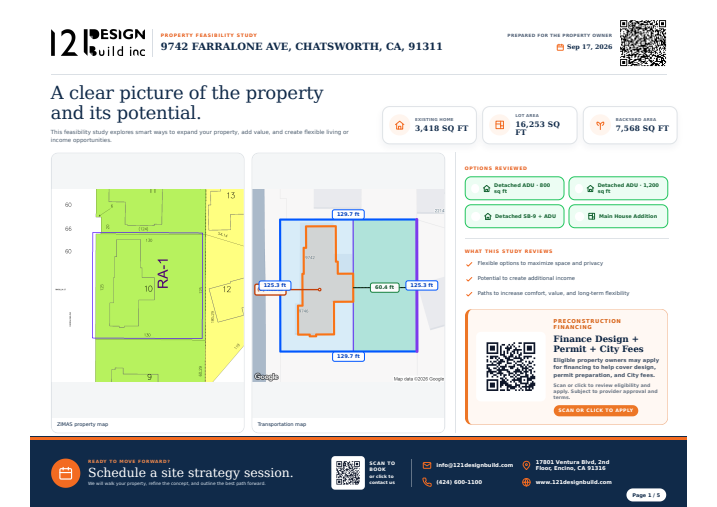
That is why the most successful ADU projects start with feasibility, not floor plans. Before a homeowner commits to a layout, the design team should verify zoning, setbacks, buildable area, utility routing, hillside or fire overlays, parking implications where applicable, and whether a standard plan or custom permit set is the better path.
How does SB 9 relate to Los Angeles ADU construction?
SB 9 is related to residential density strategy, but it is not the same as ADU law. LADBS describes SB 9 as a California law effective January 1, 2022, adding Government Code sections 65852.21 and 66411.7 for two-unit developments and urban lot splits.
For Los Angeles owners, the practical question is whether a property is better suited to an ADU, a JADU, an addition and remodel, a new detached dwelling strategy, or an SB 9 path. SB 9 can create different long-term property configurations, but it also brings distinct eligibility limits, subdivision issues, ownership considerations, and infrastructure questions.
An ADU can often be a more direct way to add rental housing, family space, or resale flexibility without subdividing the lot. SB 9 may be worth studying when the owner wants a broader redevelopment strategy, but it should be evaluated alongside ADU law rather than treated as a substitute.
How should Los Angeles ADU construction teams plan now?
Los Angeles ADU construction teams should plan around both speed and certainty. State law has improved the approval framework, but the fastest projects are still the ones with complete due diligence, coordinated architecture and engineering, and a permit set that anticipates LADBS comments before submittal.
Owners should start with three questions. First, what is the highest-value use of the lot: rental ADU, family housing, garage conversion, multifamily infill, or future redevelopment? Second, what site constraints could increase cost or delay, including utilities, fire access, hillside conditions, or nonconforming structures? Third, does the project need a custom design or can it benefit from a preapproved or repeatable plan approach?
For investors and small developers, ADUs are increasingly part of a portfolio strategy. A multifamily ADU analysis can identify underused parking areas, service yards, or non-livable building space, but the economics depend on construction sequencing, tenant coordination, utility capacity, and long-term operations.
Key Takeaways
- California ADU law is current law, and HCD's March 2026 handbook reflects changes effective through January 1, 2026.
- AB 68, AB 881, and SB 13 helped create the modern ADU framework by reducing review time from 120 days to 60 days and limiting barriers such as minimum lot size rules.
- Los Angeles ADU permits are still technical projects requiring zoning review, LADBS plan check, Title 24 documentation, structural design, and utility coordination.
- Multifamily properties may have expanded ADU opportunities, including detached ADUs under SB 1211, but site feasibility controls the outcome.
- SB 9 can be part of a density strategy, but it is a separate approval path from ADU and JADU permitting.
How can 121 Design Build help with Los Angeles ADU construction?
121 Design Build helps LA homeowners, property owners, and developers turn ADU policy rights into permit-ready projects. Our team evaluates the zoning, code, design, engineering, and construction implications under one roof so the project is not designed in isolation from what it will actually take to permit and build.
For a backyard home, garage conversion ADU, or JADU, start with our ADU and JADU service. If the project is part of a broader house expansion, our Addition and Remodel team can coordinate the ADU with the primary residence. If the parcel may support a larger redevelopment strategy, we can also evaluate SB9 or New Construction options.
If you are assessing a Los Angeles property for ADU feasibility, contact 121 Design Build at (424) 600-2100 or request a consultation through our contact page.
Frequently Asked Questions
What does the Construction Review ADU article mean for LA homeowners?
It means ADUs should be treated as a mainstream housing and property-value strategy, not an experimental exception. The article's core point is that California policy has made accessory dwelling units a durable category of residential construction.
How long does Los Angeles have to approve or deny an ADU application?
State ADU law generally requires a permitting agency to approve or deny a complete ADU or JADU application within 60 days when there is an existing single-family or multifamily dwelling on the lot. Completeness, corrections, and building-code issues can still affect the real project timeline.
Can I build an 800-square-foot ADU in Los Angeles?
State law protects the ability to permit an ADU of up to 800 square feet with four-foot side and rear setbacks when other applicable standards are met. Site-specific factors such as fire safety, utilities, easements, and building-code compliance still need to be verified.
Are ADUs under 750 square feet exempt from impact fees?
Under state ADU law, ADUs up to 750 square feet are exempt from impact fees. ADUs of 750 square feet or larger may be charged impact fees only in proportion to the size of the primary dwelling, though connection and capacity charges require separate review.
Is a garage conversion ADU easier than a new detached ADU?
A garage conversion ADU can be efficient because it uses an existing structure, but it is not automatically easier. The garage must be evaluated for foundations, framing, ceiling height, fire separation, utilities, energy compliance, and any unpermitted work.
Sources
- Construction Review: ADU Construction Trends
- California HCD: Accessory Dwelling Unit Handbook
- City of Los Angeles: About ADUs
- LADBS: Accessory Dwelling Unit
- California Open Data: HCD APR Data
This article is general information from a design-build and permitting perspective and is not legal advice.
#LosAngelesADU #ADUConstruction #CaliforniaADU #LADBS #AccessoryDwellingUnit #JADU #GarageConversion #DesignBuild #LosAngelesRealEstate #SB9 #HousingPolicy #PermitReady
Browse Our Related Articles & Blogs
Dive into a wide range of blog posts featuring the latest projects, creative design ideas and innovative sustainable practices. Stay informed with expert industry updates that shape the future of construction.

Frequently Asked Questions
Can’t find the answer you’re looking for? Please contact with our customer service.
Can’t find the answer you’re looking for? Please contact with our customer service.
Ready to build Smarter?
Book your free consultation today and discover how quickly we can turn your ideas into permits and long-term property value. Our team is here to guide you from the first sketch to final approval.