Los Angeles Single-Stair Apartments: Code Update


Quick answer: Los Angeles single-stair apartments are part of a national code-reform debate over whether small four- to six-story multifamily buildings should be allowed with one protected exit stair instead of two. California has not made a statewide change: current California Building Code and California Fire Code provisions still limit one-exit apartment buildings to three stories and four dwelling units per story, while AB 2252 did not enact a new statewide rule as of June 24, 2026. For Los Angeles property owners and developers, the practical takeaway is to keep designing permit submittals under today’s Title 24 requirements while watching state and local action that could affect narrow-lot infill, affordable housing, and missing-middle apartment projects.
A single-stair apartment building is a multifamily residential building in which upper floors are served by one exit stairway rather than two independent exit routes.
What are Los Angeles single-stair apartments?
Los Angeles single-stair apartments are proposed low- to mid-rise multifamily buildings, typically discussed in the four- to six-story range, that would use one heavily protected stair rather than the two-exit layouts common in California apartment design. The idea matters because Los Angeles has many narrow urban lots where fitting two stairs, long corridors, elevators, setbacks, parking, open space, utilities, and unit depth can make a small apartment project infeasible.
Under current California rules, however, this is not a design option for most apartment buildings above three stories. The Los Angeles Department of Building and Safety reported that California Building Code Section 1006.3.4 allows single-exit buildings up to three stories with a maximum of four dwelling units per story, and that Los Angeles does not currently modify that Chapter 10 provision. That means LA projects generally must comply with CBC Section 1006.3.4 unless a valid state or local code amendment changes the rule.
The policy debate is not about removing fire protection. It is about whether a small, sprinklered, smoke-controlled, tightly limited apartment building can safely trade a second stair for enhanced safeguards such as shorter travel distances, pressurized stairs, rated corridors, automatic sprinklers, smoke detection, and strict unit-count limits.
Why are Los Angeles single-stair apartments in the news now?
Los Angeles single-stair apartments are in the news because states and cities are rethinking fire and building codes as part of the broader effort to lower multifamily construction costs. The June 22, 2026 States Newsroom article republished by the Tucson Sentinel described a national trend: jurisdictions are allowing or studying one-stair apartment buildings, slower code-update cycles, and other building-code changes while fire-safety organizations warn that cost savings should not outrun life-safety analysis.
California’s version of the issue began with AB 835, signed in 2023 and codified in Health and Safety Code Section 13108.5.2. That statute required the State Fire Marshal to research standards for single-exit, single-stairway apartment houses with more than two dwelling units in buildings above three stories and submit a report to legislative committees and the California Building Standards Commission by January 1, 2026.
The Office of the State Fire Marshal later released its Single-Exit, Single Stairway Report to the Legislature. The report states that California currently does not allow single-stair, single-exit buildings exceeding three stories, recognizes that sprinklers, detection, and smoke-control strategies can reduce risk, but concludes that these measures do not fully substitute for the redundancy of two independent stairways.
What changed in California fire code for Los Angeles single-stair apartments?
No statewide California fire-code change currently allows Los Angeles single-stair apartments above three stories. The verified change was procedural: AB 835 required research and reporting, and AB 2252 proposed a path for HCD to develop future standards for single-exit, single-stairway multiunit residential buildings up to six stories.
The Assembly Housing and Community Development Committee analysis for AB 2252 states that the bill would have required HCD to research, develop, and propose building standards for single-exit, single-stairway multiunit residential buildings of up to six stories for inclusion in the next triennial edition of the California Building Standards Code. It also would have required HCD to consult with the State Fire Marshal and would have allowed cities and counties to adopt such standards during the existing residential-code moratorium.
The same analysis explains the current baseline: Title 24 Part 2 is the California Building Code, Title 24 Part 9 is the California Fire Code, and Section 1006.3.4 of both the CBC and CFC restricts one-exit apartment buildings to a maximum of three stories and four units when only one exit is provided. In plain English, a four-, five-, or six-story Los Angeles apartment building still needs more than one compliant exit unless and until the applicable code is amended.
How could Los Angeles single-stair apartments affect infill housing design?
Los Angeles single-stair apartments could make some small-lot infill housing more feasible if California or LA adopts a carefully written code path in the future. The main design benefit is geometry: removing a second stair and the corridor needed to connect two exits can free floor area for livable space, daylight, cross-ventilation, larger units, or additional units on constrained sites.
For developers, this could matter most on parcels where a standard double-loaded corridor building is too wide, too inefficient, or too expensive. A point-access building can place homes around a compact stair and elevator core, which can support family-sized units and smaller apartment buildings that fit better into existing neighborhoods.
The cost debate is real but should be handled carefully. The State Fire Marshal report says stairways generally account for 7.5% to 12.5% of total building cost in mid-rise residential projects. Pew’s 2025 research found that small four- to six-story single-stair buildings with relatively small floor plates could cost 6% to 13% less to construct than comparable dual-stair buildings, while reporting no evidence of greater fire fatality risk in modern single-stair buildings studied in New York City and Seattle from 2012 to 2024.
Why are fire-safety experts concerned about Los Angeles single-stair apartments?
Fire-safety experts are concerned because a single stair can become a single point of failure during an emergency. If smoke, heat, firefighting hose lines, panicked occupants, mobility-impaired residents, or a malfunctioning door compromises that stair, both evacuation and fire-department access can be affected.
The State Fire Marshal report says California fire departments expressed near-unanimous opposition to single-stair buildings above three stories. Their operational concern is direct: evacuees and firefighters may be forced into the same space at the same time, which can slow egress and suppression efforts. The report also notes that aerial ladder rescue is not a reliable universal backup because reach, access, setbacks, overhead conflicts, and staffing vary by jurisdiction.
From a design-build perspective, this means any future single-stair code in Los Angeles would need to be precise, not symbolic. A serious ordinance would likely need clear limits on height, units per floor, floor area, travel distance, stair pressurization, sprinkler type, corridor separation, door closers, alarm systems, inspection obligations, and fire-department access.
What should Los Angeles owners and developers do now?
Los Angeles owners and developers should not assume that four- to six-story single-stair apartments are currently permit-ready. For projects moving now, the safe permitting strategy is to design under the 2025 California Building Standards Code, effective January 1, 2026, and confirm egress early with the authority having jurisdiction.
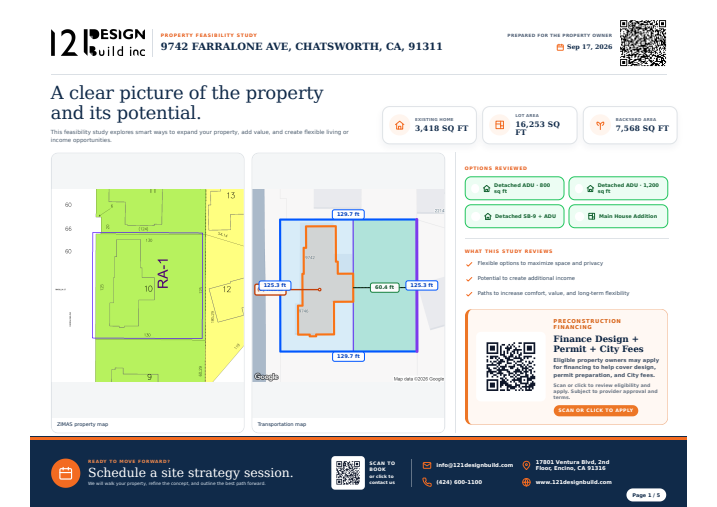
For sites that appear blocked by two-stair geometry, the best next step is a feasibility study rather than waiting for future legislation. A design-build team can test multiple schemes: three-story single-exit layouts where allowed, conventional four- to six-story dual-exit buildings, courtyard or small-lot alternatives, ADU or SB 9 options, and affordable housing scenarios that may qualify for separate state streamlining tools.
The timing matters. Code cycles move slowly, and California has a residential building-standard pause from October 1, 2025, to June 1, 2031, with limited exceptions. HCD’s approved building standards page confirms that the 2025 California Building Standards Code became effective January 1, 2026, which is the code environment owners should treat as controlling for current permit planning.
How can 121 Design Build help with Los Angeles single-stair apartments and code strategy?
121 Design Build helps Los Angeles property owners and developers evaluate what can be permitted now, what is speculative, and what design moves can preserve future flexibility. For ground-up apartment or mixed-use projects, our New Construction team can test site capacity, egress, construction type, unit mix, and permit sequencing before expensive drawings begin.
For deed-restricted or density-focused projects, our Affordable Housing / ED-1 work is often the most relevant path because entitlement strategy, design efficiency, and plan-check speed are tightly connected. Owners of single-family or small multifamily properties should also compare code-reform speculation against today’s proven tools, including ADU & JADU projects and SB9 lot-split or two-unit strategies where eligible.
If your LA site is narrow, underbuilt, near transit, or stalled by circulation and egress constraints, start with a feasibility conversation before committing to a project type. Contact 121 Design Build to review your parcel, zoning, code path, and permit-ready design strategy.
Key Takeaways
- California has not adopted a statewide rule allowing four- to six-story Los Angeles single-stair apartments.
- Current CBC and CFC Section 1006.3.4 generally limit one-exit apartment buildings to three stories and four units per story.
- AB 835 required the State Fire Marshal’s single-stair research report; AB 2252 proposed future standards but did not itself change the code.
- Supporters cite infill feasibility, lower construction costs, and better unit layouts; fire officials cite redundancy, evacuation, and operational concerns.
- Los Angeles owners should design current projects under today’s Title 24 rules while tracking state and local code activity.
Frequently Asked Questions
Can I build a four-story single-stair apartment building in Los Angeles today?
In most cases, no. Current California Building Code and California Fire Code Section 1006.3.4 restrict one-exit apartment buildings to a maximum of three stories and four dwelling units per story.
What was AB 835?
AB 835 was the 2023 California law that required the State Fire Marshal to research single-exit, single-stairway apartment houses above three stories and report to legislative committees and the California Building Standards Commission by January 1, 2026. It was a study mandate, not a direct authorization to build taller single-stair apartments.
What was AB 2252?
AB 2252 was a 2026 proposal by Assemblymember Alex Lee related to single-stair residential buildings. Committee analysis described it as requiring HCD to develop standards for single-exit, single-stairway multiunit residential buildings up to six stories, but it had not changed California code as of June 24, 2026.
Would single-stair apartments be cheaper to build?
They may be cheaper on some small infill sites because a second stair and connecting corridors can consume significant floor area. Verified studies and reports cite potential savings, but actual savings depend on construction type, fire-protection upgrades, site geometry, unit count, and local plan-check requirements.
Are single-stair apartments safe?
The answer depends on the exact building, code conditions, fire-protection systems, maintenance, and fire-department access. Research cited by supporters found strong safety records in modern examples, while the California State Fire Marshal and fire-service organizations emphasize that a second independent exit provides redundancy that active systems cannot fully replace.
Sources
- California Health and Safety Code Section 13108.5.2, AB 835 single-stair report requirement
- CAL FIRE Office of the State Fire Marshal Single-Exit Stair Work Group and report
- Assembly Housing and Community Development Committee analysis of AB 2252
- California HCD approved building standards and 2025 Title 24 effective date
This article is general information from a design-build and permitting perspective and is not legal advice.
#LosAngelesHousing #SingleStair #FireCode #Title24 #MultifamilyHousing #LAInfill #AffordableHousing #DesignBuild #Architecture #Permitting #ADU #SB9
Browse Our Related Articles & Blogs
Dive into a wide range of blog posts featuring the latest projects, creative design ideas and innovative sustainable practices. Stay informed with expert industry updates that shape the future of construction.


Frequently Asked Questions
Can’t find the answer you’re looking for? Please contact with our customer service.
Can’t find the answer you’re looking for? Please contact with our customer service.
Ready to build Smarter?
Book your free consultation today and discover how quickly we can turn your ideas into permits and long-term property value. Our team is here to guide you from the first sketch to final approval.