LA's New Starter Home Rules for 2027: Split Your Encino Lot Into Small Homes or Build a Backyard ADU - Costs, Permits and Who to Hire


LA's New Starter Home Rules for 2027: Split Your Encino Lot Into Small Homes or Build a Backyard ADU - Costs, Permits and Who to Hire
Quick answer
Starting with applications filed on or after January 1, 2027, SB 1116 (Chapter 808, Statutes of 2026, signed September 29, 2026) strengthens California's Starter Home Revitalization Act. On an eligible lot, a city must measure height in feet rather than stories, cannot require a front setback over 10 feet from the original lot line, and cannot require setbacks between the new lots except where the Building Code requires them. For most Encino owners with a house already on the lot, the single-family starter home path only works if the lot is vacant (or the structure is abandoned and uninhabitable), so a backyard ADU or an SB 9 split is often the more realistic first step. The right choice depends on your zoning, fire zone status and whether you want to sell separate homes or keep the property and rent.
Short definitions
- Starter Home Revitalization Act (SHRA): State law (Government Code sections 65852.28, 65914.4.5 and 66499.41) that requires ministerial approval of small subdivisions of up to 10 lots or units, with no CEQA review, public hearings or appeals.
- SB 684 (2023): Created the fast-track subdivision path for multifamily-zoned lots.
- SB 1123 (2024): Extended the path to vacant lots zoned for single-family homes. In Los Angeles it took effect July 1, 2025.
- SB 1116 (2026): Amends the SHRA for applications received on or after January 1, 2027.
- ADU: Accessory dwelling unit, a second home on the same lot that generally cannot be sold separately from the main house.
- SB 9: State law that allows a lot split and up to two homes per lot in single-family zones, with its own owner-occupancy and size rules.
Key Takeaways
- SB 1116 applies to SHRA applications received on or after January 1, 2027.
- Height limits must be measured in feet, not number of stories, and cannot be set lower than the underlying zoning allows on single-family sites.
- Front setbacks are capped at 10 feet from the original lot line; internal setbacks between new lots are barred except as the Building Code requires.
- Projects are limited to 10 new lots or units, with an average of 1,750 net habitable square feet per unit.
- Single-family-zoned sites must be vacant and no larger than 1.5 acres; high and very high fire hazard severity zones are excluded.
- Los Angeles must approve or deny a complete SHRA application within 60 days.
- One combined team for design, subdivision map and building permits reduces the risk of a map that does not match a buildable house plan.
What does SB 1116 actually change for 2027?
SB 1116 was signed by Governor Newsom on September 29, 2026 and chaptered as Chapter 808, Statutes of 2026. California YIMBY describes it as strengthening the SHRA by increasing design flexibility, updating definitions and adding reporting requirements. According to the Assembly Local Government Committee analysis and the chaptered text, a city may not apply objective standards to an SHRA project that:
- Restrict the number of floors, other than a height limit that applies only to the physical height of the building based on the underlying zoning.
- Impose a front setback from the original lot line greater than 10 feet, or internal setbacks between the newly created parcels, except as required by the California Building Standards Code.
- Impose a floor area ratio below 1.25 (replacing the earlier 1.0 and 1.25 tiers by unit count).
- Physically preclude units at least as large as the 1,750 square foot average the law allows.
The bill also makes recorded covenants and deed restrictions that would block an eligible SHRA project unenforceable, with an exception for common interest developments such as HOAs, and requires cities to report SHRA applications and approvals to the state starting with the report due April 1, 2028.
Who qualifies in Los Angeles today?
Los Angeles City Planning lists these eligibility rules for SHRA projects under SB 684 and SB 1123:
- Zoning: Multifamily zones (R2, RD, RW2, R3, RAS3, R4, RAS4, R5 and all C zones), or single-family zones (A, RA, RE, RS, R1, RU, RZ and RW1) only if the lot is vacant.
- Vacant: No permanent structure when the application is submitted, unless the structure is abandoned and uninhabitable.
- Site size: No larger than 5 acres in multifamily zones or 1.5 acres for vacant single-family lots.
- Minimum new lot size: 600 square feet in multifamily zones or 1,200 square feet for vacant single-family lots.
- Unit count: No more than 10 lots and 10 units, not counting a remainder parcel and certain ADUs or JADUs.
- Home size: Average total floor space of no more than 1,750 net habitable square feet.
- Exclusions: High or Very High Fire Hazard Severity Zones, habitat and conservation areas, and sites with tenant occupancy in the past 5 years, rent-stabilized units, affordability covenants or an Ellis Act withdrawal in the past 15 years.
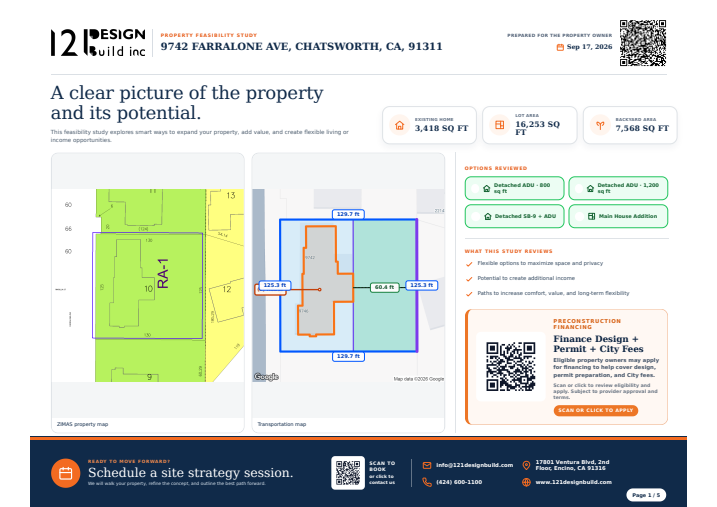
The city's ZIMAS map has an SHRA / SB 684 Eligibility link for each address, which is the best first check. Parts of Encino, especially hillside areas south of Ventura Boulevard, may fall in a fire hazard zone, so confirm before you design anything.
Can I split my Encino lot if a house is already on it?
Under the single-family path, the lot must be vacant, so an occupied house on an R1 or RE lot generally rules it out. City Planning notes that projects needing demolition of a single-family home must still comply with the Housing Crisis Act and the city's Resident Protections Ordinance, and that a home occupied by tenants in the past 5 years disqualifies the site. If your lot is zoned multifamily or commercial, the existing house does not automatically disqualify it, but renter protections still apply. If your lot does not qualify, SB 9 or an ADU may be the better route.
Starter homes vs. a backyard ADU vs. SB 9: which fits an Encino owner?
- SHRA starter homes: Best for a vacant or multifamily-zoned lot where you want several small homes on separate lots or condos that can be sold. It needs a parcel map (up to 4 lots) or tract map (5 to 10 lots) plus building permits.
- Backyard ADU: Best when you want to keep the main house and add a rental or family unit. There is no subdivision map, and the ADU generally stays on the same lot as the main house.
- SB 9: Lets a single-family lot be split and allows up to two homes per lot, even with a house already there, subject to its own owner-occupancy, size and tenant rules.
The quick test: if you want to keep and rent, look at an ADU. If you have an occupied house and want separate lots, look at SB 9. If the lot is vacant or zoned for multifamily and you want for-sale homes, the 2027 SHRA rules are worth a serious look.
What drives the cost of each path?
We do not publish cost estimates without a site visit, because every lot is different. The biggest cost drivers are:
- Map and survey work: SHRA and SB 9 both need surveyed subdivision maps; ADUs do not.
- City fees: Los Angeles charges its normal parcel map or tract map fees for SHRA applications. Use the City Planning Fee Estimator for current amounts.
- Utilities: Separate lots usually need separate water, sewer and electrical services, which an ADU may be able to share.
- Site conditions: Slope, soils, protected trees and fire zone rules.
- Number and size of homes: More small homes mean more foundations, roofs and kitchens, even if each is smaller.
- Design efficiency: The new height-in-feet rule can allow three-story townhome plans, which changes framing, stair and structural costs.
How long do permits take?
Los Angeles City Planning must approve or deny a complete SHRA application within 60 days, and the application is not considered complete until fees from the other advisory agencies are paid. The map can be processed alongside building plans, and the city may encourage concurrent approval of the housing. Building permit review, utility work and construction time come on top of that and vary by project.
Who should I hire for a starter home split?
An SHRA project has three pieces that must fit together: the subdivision map, the house designs and the building permits. When different firms handle each piece, a map can be approved with lot lines, driveways or utility routes that the house plans cannot use. A design-build team that handles the site plan, map coordination, architecture, engineering and construction under one contract can check every lot against the new height, setback and floor area rules before anything is filed. Ask any firm you interview to show you how they coordinate the surveyor, civil engineer and architect, and who is responsible if the map and plans conflict.
How 121 Design Build can help
121 Design Build Inc. is a design-build firm based in Encino that helps Los Angeles homeowners compare ADU, SB 9 and starter home options for their specific lot. We can review your zoning and ZIMAS eligibility, sketch what fits, and coordinate design, permits and construction as one team. Call (424) 600-2100 or visit us at 17801 Ventura Blvd, 2nd floor, Encino, CA. Learn more at 121designbuild.com.
FAQ
When does SB 1116 take effect?
It applies to SHRA applications received on or after January 1, 2027.
Does SB 1116 let me build three-story homes?
It bars cities from limiting the number of stories on SHRA projects, but the physical height limit in feet from the underlying zoning still applies.
How many homes can I build?
Up to 10 new lots or units, excluding a remainder parcel and certain ADUs or JADUs, with an average of no more than 1,750 net habitable square feet per unit.
Can neighbors or an old deed restriction stop the project?
SHRA approvals are ministerial, with no public hearing or appeal. SB 1116 also makes covenants that would block an eligible SHRA project unenforceable, except inside common interest developments such as HOAs.
Is an ADU simpler than a lot split?
Usually yes, because an ADU needs no subdivision map. The trade-off is that the ADU generally cannot be sold separately from the main house.
Sources
- SB 1116 chaptered text (LegiScan)
- Assembly Local Government Committee analysis of SB 1116
- California YIMBY: Governor Newsom signs SB 1116
- Los Angeles City Planning: Starter Home Revitalization Act (SB 684/1123)
- Allen Matkins: SB 1116 legal alert
- ZIMAS parcel lookup
This article is general information, not legal advice. Eligibility depends on your specific lot; confirm with Los Angeles City Planning and qualified professionals before you file.
#SB1116 #StarterHomes #EncinoHomes #LosAngelesADU #SB9 #LotSplit #DesignBuild #121DesignBuild
Browse Our Related Articles & Blogs
Dive into a wide range of blog posts featuring the latest projects, creative design ideas and innovative sustainable practices. Stay informed with expert industry updates that shape the future of construction.
Frequently Asked Questions
Can’t find the answer you’re looking for? Please contact with our customer service.
Can’t find the answer you’re looking for? Please contact with our customer service.
Ready to build Smarter?
Book your free consultation today and discover how quickly we can turn your ideas into permits and long-term property value. Our team is here to guide you from the first sketch to final approval.