Los Angeles ADU Rules After California’s AB 1033


Quick answer: Los Angeles ADU rules have not changed in the same way San José’s rules did: California’s AB 1033 allows cities to opt in and let ADUs be sold separately as condominiums, but it does not automatically make every ADU independently saleable. The August 27, 2026 MyFolsom.com article highlights California’s first ADU condominium sale in San José, where a 749-square-foot ADU sold for $530,000, but Los Angeles owners should treat separate ADU sales as a local ordinance issue, not a statewide entitlement. For LA homeowners, the practical takeaway is to design ADUs for long-term flexibility, rental use, family housing, and future policy changes while confirming current City of Los Angeles requirements before relying on resale assumptions.
AB 1033 is a California housing law, chaptered as Chapter 752, Statutes of 2023, that authorizes local agencies to adopt ordinances allowing a primary dwelling and ADU to be separately conveyed as condominiums under specified conditions.
What changed in Los Angeles ADU rules after AB 1033?
Los Angeles ADU rules changed indirectly because AB 1033 gave the City of Los Angeles the authority to create a separate-sale ADU ordinance, but the state law itself did not automatically legalize separate sales in every city. The bill, approved by the Governor and filed with the Secretary of State on October 11, 2023, amended prior Government Code provisions and is now reflected in the recodified State ADU Law at Government Code sections 66310 through 66342.
Before AB 1033, California law generally allowed an ADU to be rented separately from the main home but not sold separately, except through a narrow nonprofit affordable-homeownership path with qualified buyers and long-term affordability controls. AB 1033 added a broader local-option pathway: a city or county may adopt an ordinance allowing the primary home and ADU to become condominium interests, subject to the Davis-Stirling Common Interest Development Act, the Subdivision Map Act, safety inspection requirements, lienholder consent, utility notice, and association approval where an existing common-interest development is involved.
That distinction matters in Los Angeles. A backyard home may be legal to build, rent, or use for family housing, while still not being legal to sell as a stand-alone condominium unless the local jurisdiction has adopted and implemented the AB 1033 framework.
Why did the San José ADU condo sale matter for Los Angeles ADU rules?
The San José sale matters because it proved the AB 1033 model can move from legislation to an actual closing, but it does not mean Los Angeles ADU rules now match San José’s. According to the City of San José, California’s first ADU condominium sale closed in June 2026 for $530,000; the home was a 749-square-foot, two-bedroom, one-bath ADU on Josefina Street near downtown San José.
San José had already acted locally. The city says its City Council approved Ordinance No. 31095 in June 2024, incorporating state provisions that allow qualifying permitted ADUs to be conveyed through a Parcel Map. That local implementation is why San José could produce the first headline transaction.
The MyFolsom.com article used that sale to ask whether California created a solution or a problem. For Los Angeles, the better question is more specific: can an ADU add useful housing and property value without creating unrealistic assumptions about resale, parking, privacy, utilities, or neighborhood infrastructure? The answer depends on site planning, permitting strategy, and the owner’s exit plan.
What is the current AB 1033 status in Los Angeles?
As of September 7, 2026, the City of Los Angeles has an active Council File, 25-0753, titled “AB 1033 (Ting, Chapter 752, Statutes of 2023) / Accessory Dwelling Units (ADU) / Separate Sale or Conveyance / Condominiums.” The file shows the motion was introduced on July 1, 2025, and the Council adopted the item on September 10, 2025, instructing the Planning Department, with assistance from the City Attorney, to prepare and present an ordinance to implement AB 1033.
The important permitting point is that a Council motion is not the same thing as a fully operative local ordinance for every property. Until Los Angeles adopts and implements a final ordinance with administrative procedures, applicants should not design a financial model around an immediate separate ADU sale. Owners should instead verify the current status with City Planning, LADBS, title professionals, lenders, and legal counsel before assuming condominium conversion is available.
Los Angeles already recognizes ADUs as secondary residential units and provides an LADBS ADU Standard Plan Program intended to simplify permitting for repeatable ADU designs. But a faster plan-check pathway and a separate-sale condominium pathway solve different problems. One helps get a dwelling permitted; the other changes property ownership structure.
What properties are affected by Los Angeles ADU rules?
Los Angeles ADU rules primarily affect residential lots with an existing or proposed primary residence, including single-family properties and many multifamily properties. Under state law, ADUs may be attached, detached, converted from existing space, or created within multifamily buildings, and JADUs are a smaller statutory category generally capped at 500 square feet.
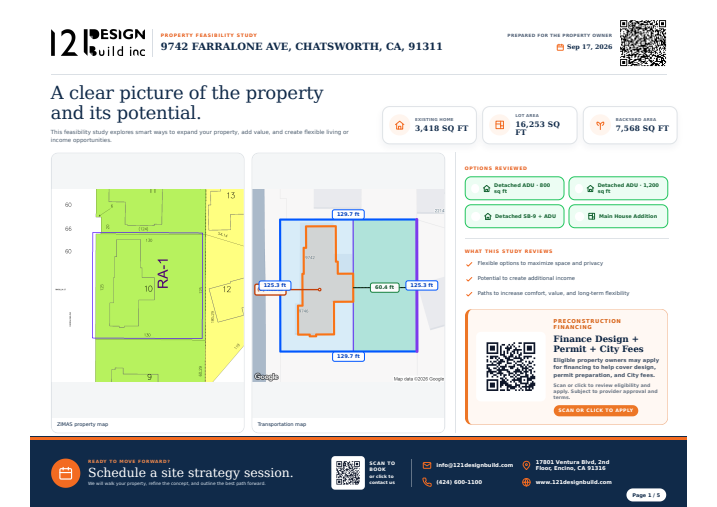
For Los Angeles homeowners, the affected properties range from San Fernando Valley lots with detached garages to hillside homes, duplexes, fourplexes, and multifamily parcels with underused interior or parking areas. Site-specific constraints still matter. Fire hazard zones, hillside conditions, utility capacity, sewer availability, structural conditions, setbacks, easements, and rent-stabilized tenant issues can change the feasibility of an ADU even when state law supports approval.
The most affected people are homeowners seeking rental income or family housing, small developers evaluating infill housing, multifamily owners looking for additional units, buyers seeking lower-cost ownership options, and neighbors concerned about parking, privacy, and construction impacts. In Los Angeles, these interests often intersect on tight urban lots where design quality and permit accuracy carry real consequences.
Do Los Angeles ADU rules make ADUs a solution or a problem?
Los Angeles ADU rules make ADUs a useful housing tool, but not a cure-all. ADUs can add rental housing, create multigenerational living arrangements, and help owners unlock underused land without assembling large development sites. HCD’s 2026 ADU Handbook reports that annual ADU permits in California rose from 1,336 in 2016 to 30,354 in 2024, and that ADUs represented more than 26.6 percent of all homes permitted statewide in 2024.
The problems are real, too. A poorly planned ADU can create privacy conflicts, awkward access, inadequate storage, difficult utility routing, drainage issues, and costly plan-check corrections. A financial model based on future separate sale can also fail if the city has not implemented AB 1033, if the lender refuses consent, or if condominium mapping and shared-maintenance obligations prove more complex than expected.
From a design-build perspective, the safest conclusion is that ADUs work best when they are planned as durable housing first and speculative financial instruments second. Good ADU design should address livability, light, acoustics, entries, trash access, utility routing, fire access, privacy, and future maintenance from the first feasibility study.
How should Los Angeles homeowners plan an ADU now?
Los Angeles homeowners should plan an ADU around current permit rules, site feasibility, and multiple future uses rather than one hoped-for resale scenario. A strong ADU strategy starts with zoning verification, title and easement review, utility assessment, code analysis, and a realistic construction budget before schematic design begins.
Owners considering an AB 1033 strategy should ask a second set of questions. Would the lender consent to a condominium plan? Can utilities be separated or clearly allocated? How would shared driveways, yards, walls, roofs, drainage, insurance, and maintenance be governed? Would an HOA-like structure be required? Would the ADU still make financial sense if it can only be rented or used by family?
These questions are especially important in Los Angeles because many parcels have older structures, nonconforming conditions, hillside grading issues, or prior unpermitted work. The difference between a clean permit path and a delayed one often comes down to early documentation and coordinated architecture, engineering, and construction planning.
Key Takeaways
- AB 1033 became law on October 11, 2023, and took effect January 1, 2024, but it requires local opt-in before ADUs can be sold separately as condominiums.
- San José produced California’s first ADU condominium sale in June 2026 after adopting a local ordinance implementing the AB 1033 framework.
- The City of Los Angeles has advanced Council File 25-0753 to prepare an AB 1033 ordinance, but owners should verify whether a final operative ordinance applies before relying on separate sale.
- California ADU law now appears mainly in Government Code sections 66310 through 66342 after statutory recodification.
- For LA owners, the strongest ADU projects are designed for flexible use: rental income, family housing, resale value, and potential future ownership changes.
How can 121 Design Build help with Los Angeles ADU rules?
121 Design Build helps Los Angeles property owners turn ADU feasibility into permit-ready design and buildable construction strategy. For homeowners focused on a backyard unit, garage conversion, or JADU, our ADU & JADU service is the most direct starting point because it integrates zoning review, design, permit documentation, and construction thinking under one roof.
Some owners need a broader property strategy. A detached ADU may pair with an Addition & Remodel plan when the main house also needs upgrades, while larger infill opportunities may require New Construction planning. Where a site may support lot-split or small-scale development alternatives, our SB9 service can help compare an ADU path against other value-unlocking options.
The goal is not to chase headlines. The goal is to know what a Los Angeles property can legally, physically, and financially support before committing to drawings, permit fees, or construction. To discuss a site-specific ADU strategy, contact 121 Design Build at our Encino office or call (424) 600-2100.
Frequently Asked Questions
Can I sell my Los Angeles ADU separately from my house?
Not automatically. AB 1033 allows cities and counties to adopt local ordinances permitting separate ADU sales as condominiums, but the local jurisdiction must implement that framework before an owner can rely on it.
What did AB 1033 change for California ADU law?
AB 1033 authorized local agencies to allow separate conveyance of a primary dwelling and ADU as condominium interests. It replaced the prior broader prohibition with a local-option system subject to condominium, subdivision, safety, lienholder, utility, and association requirements.
Does an ADU in Los Angeles still need permits?
Yes. ADUs and JADUs require proper permitting, and LADBS reviews plans for zoning, building, residential, green code, and site-specific requirements. State law limits local discretion in many situations, but it does not eliminate building-code compliance.
Is a detached ADU better than a garage conversion in Los Angeles?
It depends on the site and the owner’s goals. A garage conversion can be efficient when the structure is suitable, while a detached ADU may provide better privacy, layout, rental value, and long-term flexibility if the lot can support it.
Should I design an ADU for future condominium conversion?
It can be wise to preserve future flexibility, but the ADU should still work as a rental or family unit if separate sale is unavailable. Early planning should consider utilities, access, privacy, maintenance, and lender or title issues that may affect any future condominium strategy.
Sources
- MyFolsom.com: ADUs: Did California Create a Solution, or a Problem?
- California Legislative Information: AB 1033 bill text
- California HCD: Accessory Dwelling Unit Handbook, March 2026
- City of Los Angeles Council File 25-0753
- City of San José: first ADU condominium sale in California
This article is general information for design-build and permitting context and is not legal advice.
#LosAngelesADU #LADesignBuild #AB1033 #CaliforniaADU #ADURules #ADUPermits #BackyardHomes #LARealEstate #AccessoryDwellingUnit #JADU #SB9 #InfillHousing
Browse Our Related Articles & Blogs
Dive into a wide range of blog posts featuring the latest projects, creative design ideas and innovative sustainable practices. Stay informed with expert industry updates that shape the future of construction.

Frequently Asked Questions
Can’t find the answer you’re looking for? Please contact with our customer service.
Can’t find the answer you’re looking for? Please contact with our customer service.
Ready to build Smarter?
Book your free consultation today and discover how quickly we can turn your ideas into permits and long-term property value. Our team is here to guide you from the first sketch to final approval.