
LA Affordable Housing Development: 300+ New Units

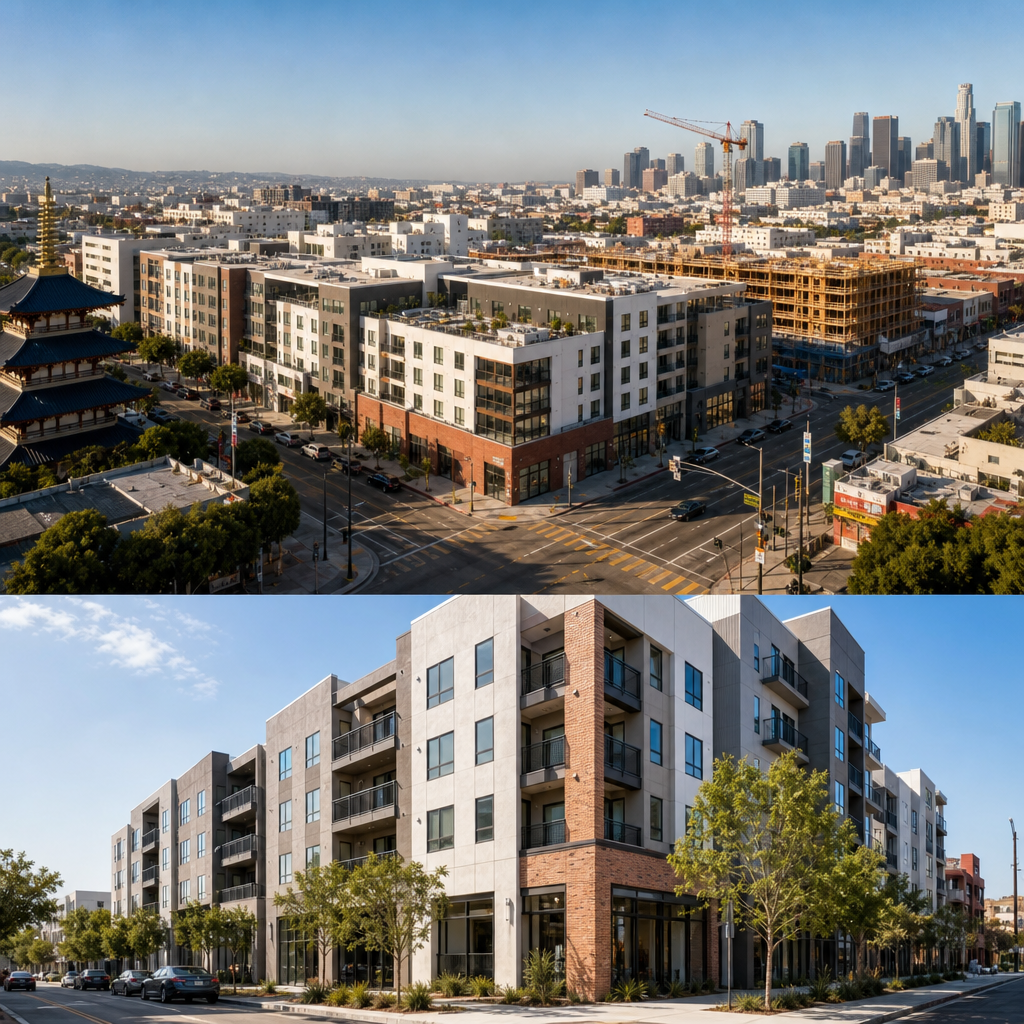
Quick answer: LA affordable housing development is moving forward with more than 300 new homes tied to two central Los Angeles projects: Go For Broke Plaza & First Street North Residences in Little Tokyo and a 100% affordable project at 708-712 S. Gramercy Drive in Koreatown. The Little Tokyo project is a 248-unit mixed-use, transit-oriented development with permanent supportive housing set-asides, while the Gramercy project is a seven-story building planned for roughly 100 restricted affordable apartments plus a manager unit. For property owners and developers, the story shows how Los Angeles is using public land, density bonus law, ED1 streamlining, and affordable housing finance to move dense infill projects from entitlement to construction faster.
Executive Directive 1, commonly called ED1, is the City of Los Angeles process that expedites qualifying shelter and 100% affordable rental housing projects through ministerial review, coordinated clearances, and faster approvals.
What is the LA affordable housing development news near downtown Los Angeles?
The LA affordable housing development news is that two projects near downtown Los Angeles are adding more than 300 affordable homes in Little Tokyo and Koreatown. The Daily Trojan reported the story on September 9, 2026, and project records identify the two developments as First Street North Residences at 232 Judge John Aiso Street and the Gramercy Drive affordable housing project at 708-712 S. Gramercy Drive.
The larger project, Go For Broke Plaza & First Street North Residences, is being developed by Little Tokyo Service Center with Go For Broke National Education Center. LTSC describes the project as one of the City of LA’s largest 100% affordable housing developments, with 248 affordable units, 80 permanent supportive housing set-asides, approximately 40,000 square feet of ground-floor retail and cultural space, and a location in the heart of historic Little Tokyo.
The second project is in Koreatown, where City Planning case records list ADM-2024-1212-DB-HCA-ED1 for 708 S. Gramercy Drive. The case was filed on February 21, 2024, assigned on June 6, 2024, and approved on October 17, 2024. The entitlement request cites LAMC Section 12.22 A.25, Los Angeles’ density bonus section, for a seven-story 100% residential development with density bonus incentives and waivers.
Why does this LA affordable housing development matter for Los Angeles owners?
This LA affordable housing development matters because it shows which sites and project types are gaining traction in the Los Angeles entitlement environment. Both projects are dense, urban, multifamily infill developments near transit and services, and both rely on tools that are now central to affordable housing delivery in Los Angeles: public land, density bonus incentives, ED1 processing, tax credit financing, and supportive housing partnerships.
For private owners, the Gramercy example is especially instructive. Urbanize LA reported that the site began as a predominantly market-rate proposal with 55 apartments in 2023 before being reworked into a larger affordable housing project. That shift reflects a broader market pattern: in some locations, affordable housing incentives can make additional height, unit count, reduced parking, or streamlined review more valuable than a conventional market-rate plan.
For civic and nonprofit sites, the Little Tokyo project shows the power of long-term land control. LTSC states that the City of Los Angeles approved an amendment in 2021 to ground lease the site to LTSC and Go For Broke National Education Center for $1 per year over 99 years. That structure allowed the project team to pair housing, cultural preservation, legacy retail, and open space on land that had been used as surface parking.
What changed from the prior rules or prior project plans?
The main change is not a new state bill; it is how Los Angeles has been applying and refining ED1, density bonus law, and affordable housing procedures to move 100% affordable projects faster. LA City Planning states that ED1 was most recently updated on July 1, 2024, adding tenant protections, historic-resource protections, environmental safeguards for high-fire-risk and industrial-area projects, enhanced design standards, and limits on some off-menu density bonus incentives and waivers.
Before ED1, many affordable housing projects still moved through slower, more fragmented entitlement and clearance processes. ED1 created a coordinated ministerial pathway for qualifying 100% affordable rental projects that do not need legislative actions such as a general plan amendment, zone change, or height district change. City records also show a later Council File, 23-0623-S1, for codifying procedures and performance standards related to ED1 and 100% affordable housing projects into the Los Angeles Municipal Code, with an ordinance effective date listed as December 19, 2025.
At the project level, the Gramercy site appears to show the clearest before-and-after change. The earlier plan was a smaller, largely market-rate project. The later ED1-linked application became a seven-story 100% affordable development using LAMC Section 12.22 A.25 density bonus provisions.
Which properties and residents are affected by the new affordable units?
The affected properties are 232 Judge John Aiso Street in Little Tokyo and 708-712 S. Gramercy Drive in Koreatown. The affected residents are lower-income households eligible for restricted affordable rental housing, supportive housing residents, and, for First Street North, households connected to permanent supportive housing programs including homeless veterans and unhoused people living with HIV/AIDS, according to LTSC’s project description.
First Street North includes a broad mix of unit types: studios, one-bedroom, two-bedroom, and three-bedroom apartments, plus manager units. That matters because affordable housing production in Los Angeles often skews toward studios and one-bedroom units; family-sized affordable apartments remain harder to deliver because they require larger floor plates, deeper subsidies, and more careful construction cost control.
The Gramercy project is different in scale and program. Urbanize LA reported that the project calls for a seven-story building with 101 studio and one-bedroom apartments and 17 parking spaces, with all apartments reserved for low- and moderate-income renters. The city case summary describes the entitlement as a 100% residential development under the density bonus program.
What does ED1 mean for LA affordable housing development strategy?
ED1 means Los Angeles affordable housing projects can be evaluated through a more predictable path if they meet strict eligibility rules. City Planning describes ED1 as applying to shelter projects and 100% affordable housing projects with active or valid City Planning applications or referral forms, as well as eligible projects under review by LADBS or LAHD.
In practice, ED1 is most useful when the design team can prove eligibility early, avoid discretionary triggers, and submit a coordinated entitlement, code, accessibility, and building-permit strategy. The fast path does not eliminate technical review. It makes front-end precision more important because objective standards, housing replacement rules, affordability covenants, fire-life-safety requirements, and construction documentation still have to be resolved.
That is why permit-ready affordable housing in Los Angeles depends on more than a site plan. A successful package typically needs zoning analysis, density bonus calculations, unit mix strategy, parking analysis under state and local law, energy and accessibility coordination, and an early read on whether the project can stay ministerial.
Key Takeaways
- More than 300 affordable homes are tied to two central Los Angeles projects in Little Tokyo and Koreatown.
- First Street North Residences is planned as a 248-unit 100% affordable mixed-use development with 80 permanent supportive housing set-asides.
- The 708-712 S. Gramercy Drive project was approved by LA City Planning on October 17, 2024 under case ADM-2024-1212-DB-HCA-ED1.
- The Gramercy entitlement cites LAMC Section 12.22 A.25, Los Angeles’ density bonus provision, and ED1 affordable housing processing.
- For owners and developers, the opportunity is strongest on sites where zoning, transit access, affordability rules, financing, and constructability align.
How can property owners evaluate affordable housing or infill development sites in Los Angeles?
Property owners should start by testing whether the site can support a financially and technically feasible housing program before assuming ED1 or density bonus incentives will solve every constraint. The highest-value early questions are zoning capacity, existing tenant or RSO issues, historic-resource risk, parking requirements, utility capacity, fire access, and whether the project can avoid a discretionary or legislative action.
121 Design Build helps Los Angeles property owners and developers evaluate these questions from the beginning, not after a concept has already become expensive to revise. For ground-up apartment or mixed-use projects, our New Construction team can translate zoning capacity into realistic massing, plans, and permit documentation. For 100% affordable or ED1-focused work, our Affordable Housing / ED-1 service is built around fast, coordinated design and permitting strategy.
Smaller owners may also need to compare multifamily redevelopment with other value-add paths. Depending on the parcel, an ADU & JADU strategy, SB9 lot or unit analysis, or an Addition & Remodel plan may be more practical than a full affordable housing redevelopment. To understand what your site can support, contact 121 Design Build for a feasibility conversation.
Frequently Asked Questions
How many affordable units are being added near downtown Los Angeles?
The two highlighted projects account for more than 300 new affordable homes in central Los Angeles. First Street North Residences is planned for 248 units, while the Gramercy Drive project is planned for roughly 100 restricted affordable units plus a manager unit.
What is ED1 affordable housing in Los Angeles?
ED1 affordable housing in Los Angeles refers to qualifying 100% affordable rental projects processed under Mayor Karen Bass’ Executive Directive 1. The process is intended to expedite ministerial approvals, clearances, and permitting for eligible shelter and affordable housing projects.
Does ED1 apply to every multifamily project in Los Angeles?
No. ED1 is limited to eligible shelter projects and 100% affordable housing projects that meet City Planning and LAHD requirements. Projects that require legislative actions, certain discretionary approvals, or fail eligibility standards may not qualify for ED1 streamlining.
Why are Little Tokyo and Koreatown seeing affordable housing activity?
Little Tokyo and Koreatown have strong transit access, high renter demand, and parcels where multifamily infill can make planning sense. The Little Tokyo project also benefits from public land and a nonprofit development structure, while the Koreatown project uses density bonus and ED1 tools.
Can a private property owner use similar incentives?
Yes, in some cases. A private owner may be able to use density bonus law, ED1, AB 2011, TOC-style incentives where still applicable to vested projects, or other Los Angeles housing programs, but eligibility depends on the site, zoning, affordability mix, existing tenants, and required approvals.
Sources
- Los Angeles City Planning: Executive Directive 1 overview
- Los Angeles City Planning case ADM-2024-1212-DB-HCA-ED1 for 708 S. Gramercy Drive
- Little Tokyo Service Center: Go For Broke Plaza & First Street North Residences
- Los Angeles Housing Department staff report on First Street North funding and site control
This article is general information from a design-build and permitting perspective and is not legal advice.
#LAAffordableHousing #LosAngelesDevelopment #ED1 #DensityBonus #Koreatown #LittleTokyo #DTLA #PermitReady #MultifamilyHousing #SupportiveHousing #DesignBuild #121DesignBuild
Browse Our Related Articles & Blogs
Dive into a wide range of blog posts featuring the latest projects, creative design ideas and innovative sustainable practices. Stay informed with expert industry updates that shape the future of construction.

Frequently Asked Questions
Can’t find the answer you’re looking for? Please contact with our customer service.
Can’t find the answer you’re looking for? Please contact with our customer service.
Ready to build Smarter?
Book your free consultation today and discover how quickly we can turn your ideas into permits and long-term property value. Our team is here to guide you from the first sketch to final approval.